Tag Archives: evidences

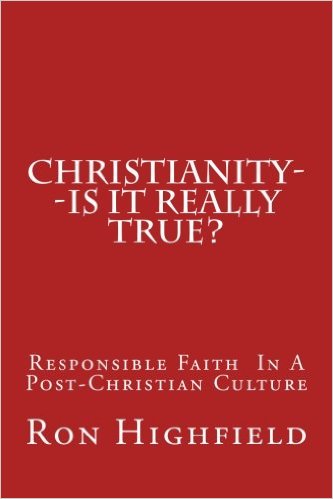
ANNOUNCING the publication of “Christianity–Is It Really True? Responsible Faith In a Post-Christian Culture”

I am excited to announce the publication of the book that includes 48 revised and edited essays from last year’s series “Is Christianity True?”

Perhaps you know an undergraduate or graduate student who could benefit from reading it. Perhaps you want to lead a small group on this theme. Perhaps you simply want a copy for yourself.

If you enjoyed the series I hope you will recommend the book to your friends. I set the price near the minimum allowed by Amazon.com, $8.95.

It is available also in Kindle. $3.49.

Read the PREFACE, which describes the contents and aims of the book:

Preface

This book is second in a series of books I’ve written in weekly installments on my blog ifaqtheology (Infrequently Asked Questions in Theology). It contains in revised form the 48 essays I wrote between August 2014 and July 2015 on the question, “Is Christianity True?” I hope that publishing them in printed form will make them accessible to individuals and groups that want to study the topics of Christian evidences and Christian apologetics. I have long felt that the most popular works on evidences and apologetics don’t quite get it right. As a whole they try to prove too much and do not take adequately into account our fallibility. They underestimate the role of the will in belief. And they too readily accept the burden of proof, which puts the case for Christianity at a decisive disadvantage. They do not take the best logical and rhetorical path from nonbelief to full Christian faith. Specifically and most disturbingly, they attempt to prove the Bible’s authority independently of faith in the resurrection of Jesus Christ from the dead. In this book I develop a different understanding of the path to faith, a different vision of the role of the will in belief and a different way of establishing the authority of the Bible.

Part One sets out the ground rules for Christian evidences. The chapters in this section will clarify the purpose, methods and limits of evidences. We will ask who bears the burden of proof and what conditions must be present before an inquirer can make a reasonable judgment to believe the Christian gospel and a responsible decision to take up the Christian way of life. We define such relevant terms as truth, reality, certainty, knowledge, faith and opinion. Finally, we will map the path from nonbelief through four decision points to full Christian faith.

Part Two takes us through the four decision points we must traverse on our way to full Christian faith. First, we must decide between atheism and belief in God. I argue that this decision depends on our choice between matter and mind as the most fundamental explanation for our world. Is the beginning and end of all things spirit or matter, life or death, intelligible or unintelligible, mind or machine? Having decided that believing in God is the most rational choice, we now confront the second decision point where we ask, “Is the mind that is evident in the intelligible order of the world impersonal or personal?” If we opt for a personal God, a third decision point confronts us with the choice between thinking of God as the highest aspect of nature or as transcendent over nature. Is God supernatural or natural? Is the world God’s creation or God’s body? The issue can also be framed as a decision between theism and panentheism, which is the idea that God is an aspect of the world neither wholly different from world nor fully identical to it. If we accept theism as the best answer to this third question, we come to the fourth decision point at which we must decide whether to remain mere theists or move into full Christian faith. At this crossroads we are required to discuss the possibility and actuality of a revelation of God in history. At the moment of decision we must assess the evidence for the bodily resurrection of Jesus Christ from the dead and reflect on the meaning of this event for the nature, identity and significance of Jesus.

Part Three marks the transition into a new phase of the argument for Christianity’s truth. The previous chapters presented an affirmative case for making a reasonable judgment for Christianity’s truth and a responsible decision to become a Christian. But now we must deal with some misunderstandings and objections to Christianity. The positive side of the argument is often called “Christian Evidences” and the defensive side is often called “Christian Apologetics” or “Defense of Christianity.” The necessity of the defensive phase of the argument rests first on the propensity of people to misunderstand what Christianity actually is and what it really teaches. How can we make a reasonable judgment or a responsible decision about Christianity unless we possess an accurate understanding of its teachings? Some people find certain versions of Christianity incredible or morally offensive or insufferably superficial, and hence hesitate to accept them. Others adopt a form of Christianity that is defective when compared to the original form taught by Jesus and the apostles. It is questionable whether one has really made an authentic decision about Christianity if the form they know is not the real thing.

The second reason for the pursuing the defensive phase of the argument arises from the barrage of objections that nonbelievers hurl against Christianity. Some raise objections to the existence of God, theism or divine revelation. They raise the problem of evil or assert that the world needs no explanation beyond itself. Others object to the moral teachings of the Bible or deny its historical accuracy. Some offer objections to the reliability of the apostolic witnesses to the resurrection of Jesus or object to the very possibility of miracles. The list is endless. And even if one thinks the case I made in the first phase of the argument is very strong, one may still be disturbed and caused to doubt by the many objections that are raised. Hence I want to reply to some of the most potent objections. Some of these objections may turn out to be based on misunderstandings of Christianity. But some may accurately represent Christianity and yet still suggest reasons to doubt or reject it.

How to Read This Book

I wrote this book as a sustained and step-by-step argument, and reading it from beginning to end may be the best way to get the most from it. But I think there are several points at which readers could enter the argument without getting lost. If you are not interested right away in the question of methods in apologetics, you could skip Part One and move directly to Part Two, which develops the four decision points on the way to full Christian faith. And even within Part Two, you could read the chapters on the fourth decision point, which focuses on the resurrection of Jesus Christ, without reading the first three. Or, you could begin with Part Three, which deals with objections to Christian faith. No matter where you begin, I hope you will read the whole book so that you can see the big picture argument.

From Evidences to Apologetics

Today I will begin a new phase of the series on the question, “Is Christianity True?” For the first 29 essays I’ve presented an affirmative case for making a reasonable judgment for Christianity’s truth and a responsible decision to become a Christian. Much more could be said in making this case—and I might insert more arguments as we move forward—but for now I want to deal with some misunderstandings and objections to Christianity. The positive side of the argument is often called “Christian Evidences” and defensive side is often called “Christian Apologetics” or “Defense of Christianity.” The necessity of the defensive phase of the argument rests first in propensity of people to misunderstand what Christianity actually is and what it really teaches. How can we make a reasonable judgment or a responsible decision about Christianity unless we possess an accurate understanding of its teachings? Some people find certain versions of Christianity incredible or morally offensive or insufferably superficial, and hence hesitate to accept them. Others adopt a form of Christianity that is defective when compared to the original form taught by Jesus and the apostles. It’s questionable whether one has really rejected or accepted Christianity if the form they know is not the real thing.

The second reason for the pursuing the defensive phase of the argument arises from the barrage of objections that non-believers hurl against the proposition of Christianity’s truth. Some raise objections to the existence of God or to theism or to divine revelation. They raise the problem of evil or assert that the world needs no explanation beyond itself. Others object to the moral teachings of the Bible or deny its historical accuracy. Some offer objections to the reliability of the apostolic witnesses to the resurrection of Jesus, or they object to the very possibility of miracles. The list is endless. And even if one thinks the case I made in the first phase of the argument is very strong, one may still be disturbed and caused to doubt by the many objections that are raised. Hence I want to reply to some of the most potent objections. Some of these objections may turn out to be based on misunderstandings of Christianity. But some may accurately represent Christianity and yet still find reasons to doubt or reject it.

I don’t have a particular order in mind in which to address misunderstandings and objections to Christianity. I will deal with them as they come to me.

I will post the first installment in this new phase immediately. Its title is: “No, My Friends, Christianity is Not for Everyone”

Presenting the Case for the Resurrection: Some Cautionary Advice for Would-be Apologists

Today we begin to address the question of the historical facticity of the resurrection of Jesus, which, as I have emphasized, is the crucial event at the origin of Christianity. All subsequent Christian history and teaching is premised on the reality of the resurrection. And as Paul readily admits, “if Christ is not risen” (1 Cor 15:14-19), the Christian message is false, the Christian way of life is useless, and the Christian hope is groundless. It has taken us four essays on the resurrection to get to this point. We had to get a feel for how the first believers understood the event of the resurrection. How else could we know what is at stake in our decision to accept or reject their witness? Now we know that to believe that Jesus was raised from the dead is to accept a radical reorientation in our worldview and a revolution in our way of life. Likewise, to reject the resurrection of Jesus is to reject all that flows from it, the forgiveness of sins, hope of the resurrection, the identity of God, the meaningfulness of suffering, and the love of God.

Allow me to remind readers that this is the twenty-fourth essay in this series on the truth of Christianity. We are now dealing with the fourth decision point on the journey from atheistic materialism to full Christian faith. In my opinion, only those who have gone through the first three decision points are ready to face the question of the historical facticity of the resurrection of Jesus. What sense does it make to present a case for the resurrection of Jesus to a materialist? Nor is a polytheist or pantheist or committed deist ready to make a rational judgment or a responsible decision about it. Perhaps, if the atheist or deist could have seen the crucifixion and burial of Jesus on Good Friday and accompanied the women to the tomb on Sunday morning to see the empty tomb and meet Jesus alive…or, if they had been struck down like Paul on the Damascus Road and heard Jesus speak directly to them, they would have come to believe in Jesus’ resurrection and the existence of God at the same time. Perhaps they would not deny the evidence gathered by their own eyes and ears. But we cannot reproduce these events for them or for ourselves. We have only the testimony of those who say they experienced them and the testimony of those who believed them.

And for those who do not want to believe in the resurrection of Jesus, there are plenty of ways to evade that conclusion. If you are an atheist materialist, you think you know apart from any historical evidence that the resurrection did not happen, because, since there is no God, God could not have raised Jesus. No evidence will move you. Deists respond much the same way. God set up the world to run on its own and does not interfere. Since God never interferes with course of natural events, God did not reverse the course of nature in Jesus’ case either. If atheists or deists bother with history at all, they see their job as finding plausible naturalistic explanations for historical reports of miracles: the supposed eye and ear witnesses were mistaken or they lied. The reports do not come from eye witnesses but from hearsay, and, whatever really happened, the story has become overlain with legend or myth.

For those who believe in the one God who made the world and sustains it in existence every moment, for those who are open to divine revelation in nature and history, and for those who have no rational or theological objections to miracles, objections that are based on presupposed atheism or deism don’t carry much weight. They are either irrelevant because they presuppose atheism when we are convinced of God’s existence or they are disingenuous because they make metaphysical objections in the guise of historical arguments.

My reading of Christian apologetic literature has led me to conclude that many of these well-intentioned works do not take the preceding cautions into account; and they make other serious mistakes that limit their value in helping people come to faith: (1) they do not take care to follow the most rational decision cascade from atheism to full Christian faith; (2) they fall into the evidentialist trap of accepting the burden of proof; (3) they give the impression of anxiety, of being over-eager to convince; or (4) they overstate their case, providing easy targets for rebuttal. Each of these mistakes in its own way deflects nonbelievers’ attention away from the seriousness of their situation and from the necessity of making a decision in the moment.

Perhaps these considerations will help you understand why I am somewhat impatient with objections to the resurrection faith that are based on atheism, deism, or any other philosophy that denies the possibility of miracles. Responding to such objections is fruitless endeavor. I am also impatient with equivocations, demands for more evidence, and alternative ways of explaining the resurrection faith that seem to be designed to evade the real issue. The division between faith and unbelief is not merely a matter of dispassionately weighing evidence in some neutral scales. It is also a matter of friendship or hostility, love or hate; this decision has an unmistakable moral dimension. Paul and the others claim they know that Jesus Christ was raised from the dead, and they staked the meaning of their entire existence on this fact. Either they are correct or they are lying or they are mistaken. You have to look them in the eyes and say, “I believe you” or “I don’t believe you.” You have to make a decision and live with it. And you have to do it now. This is a vital component of any apologetic situation. Any apologetic that does not make this clear risks failure.