Conflicting Visions Diversity and Equity

Words do not define themselves. As vocalized sounds or written letters, apart from a context, they say nothing good or bad. For they have no precise meaning. Consider the word group, diversity, equity, and inclusion. If American culture were not so deeply divided over Critical Race Theory, Social Justice Theory, cancel culture, and the negative reactions to them, hearing the words diversity, equity, and inclusion would not trigger the emotional response that it does.

Two Meanings of Diversity

Apart from that conflict, the idea of gathering a workforce with a diversity of perspectives and a variety of experiences would be considered an important strategy for achieving the goals of academic or business endeavors: discovery, innovation, and efficiency. Everyone knows that “two heads are better than one.” But it is not just a matter of numbers. Different voices challenge and balance each other to produce a better product…as long as diversity serves as a means to fulfilling the mission of the institution. The mission is the principle of unity, the end toward which all the activity aims. Harmony is dynamic, cooperative movement produced by a creative combination of unity and diversity.

However when diversity becomes an end in itself, the original mission is eclipsed or even aborted. Chaos reigns. Social conflict arises when against all common sense diversity is proclaimed to be an absolute value. Since diversity cannot possibly fulfill this role—it would produce total chaos—people begin to wonder what the real agenda is. Diversity must be contained and regulated. If the type and amount of diversity is not regulated by faithful execution of the mission of the institution, who will regulate it and to what end? We begin to suspect that it will be regulated arbitrarily in service of the private interests of now pervasive diversity officers.

Two Meanings of Equity

Apart from our situation of conflict, the word equity would strike a chord in most people similar to that evoked by the words “fairness” or “justice.” Equity pictures a state of affairs in which society’s rewards and punishments are allotted according to what one deserves because of one’s inherent dignity, character, achievements, and abilities—not on the basis of factors that have nothing to do with merit. Perhaps equity would also connote a subtle sense that fairness and justice have to be achieved by resisting the universal human tendency toward selfishness, unfairness, and injustice.*

However, apart from our polarized situation I do not think most people would think that the ideal of equity should be applied to identity groups as collectives because the measures of what one deserves, of what is fair and just—that is, dignity, character, achievements, and abilities—apply only to individual persons and their unique situations. While in the Western world all members of identity groups are believed to possess inherent dignity, individuals within groups differ greatly with respect to character, achievements, and abilities. Ironically, pursuing equity among identity groups creates inequities at the individual level. Social goods are no longer distributed fairly and justly, that is, according to an individual’s deserts as determined by dignity, character, achievements, and abilities.

Rewards and punishments would be distributed proportionately according to group identity. Implicit in this change in how rewards and punishments are distributed is also a shift in the location of the decision making process and enforcement authority. Decisions can no longer be made within the institution on the basis of individual merit and solely in service the mission of the institution, which make sense according to common sense intuitions of fairness and institutional logic. The institutional mission and common sense notions of fairness have been suborned to the external logic of identity group equity backed by government authority.

In the name of equity, fairness and justice—understood as receiving what one is due as measured by dignity, character, achievements, and ability—would be cast aside. Rewards and punishments would be distributed according to an alien principle having nothing to do with individual deserts. The same word “equity” used in different contexts means completely opposite things. One person’s good is another’s evil. What for one person is just is for another unjust. Fairness in one context is unfairness in another. No wonder there is controversy and confusion!

*Note: I am describing something similar but not identical to the concept of equity found in common law, which appeals to the ordinary person’s sense of fairness in situations where the legal system seems to be unfair.

To be continued….
Diversity, Equity, and Inclusion—Christian Ideals or Golden Calves?

Deceitful Words

Almost every day I have to endure listening to non- or even anti-Christian meanings being poured into traditional Christian words. Even worse, I hear words whose meanings are determined by non- or anti-Christian contexts proclaimed as the height of Christian orthodoxy, piety, and virtue. This experience is as painful to me as I imagine Moses’s experience was to him as he descended mountain having heard the very voice of God only to discover that Aaron and the Israelites had made a golden calf and were worshiping it as the God who brought them out of Egypt (Ex 32). Today we have a multitudes of “Israelites” and plenty of “Aarons” within Christian circles who are only too happy to assimilate Christianity to the pagan culture surrounding it. And playing word games is one way of disguising the substitution.

Some Contemporary Golden Calves

Traditional Words Are Given Alien Meanings

Some years ago I had to study the works of some very liberal theologians. One theologian, Langdon Gilkey (1919-2004), kept using the word “salvation” in an odd way. He kept saying that there is salvation in all religions. What did he mean? Did he mean that the adherents of all religions would achieve what the New Testament offers as liberation from sin, death, and the devil? Do all religions lead to the arms of Abraham, to resurrection of the dead, to union with the God and Father of our Lord Jesus Christ, to eternal life in fellowship with the Father, Son, and Holy Spirit? However as I kept reading I realized that Gilkey meant something quite different. He meant that all the major religions humanize, elevate, and spiritualize their followers in this life. These religions provide meaning, purpose, and identity. They create community, human solidarity, and ethical guidance. And this is what Gilkey meant by “salvation.” Jesus saves, Buddha saves, and Mohammed saves. They all make people better and happier.

Later in my historical studies, I discovered that retaining a traditional Christian word while shifting its meaning has been the strategy of liberal Christian theology from its beginning in around 1800 until today. In the liberal dictionary,

“Resurrection” means not that God raised Jesus bodily from the dead and that Jesus reigns as lord but that Jesus’s influence lives on and exercises a powerful force in the world.

“Atonement” is not about God actually changing the world through the death and resurrection of Jesus but about the positive impact of the teaching and example of Jesus.

The “Holy Spirit” is not the powerful presence of God witnessing to Jesus Christ and transforming people into his image but for all practical purposes is identified with the progressive spirit of the times.

“Justice” in the Bible means individual behavior that measures up to the letter and the spirit of God’s just laws. Today it has come to mean “social justice,” which is an agenda for reordering society toward equity, diversity, and inclusion.

Words with Secular Meanings Declared Christian

As examples secular/pagan meanings being imported into Christian churches and such parachurch organizations as Christian colleges I will examine the pervasive call for diversity, equity, and inclusion—aka social justice—in all spheres of modern society. As someone who lives and works in higher education—today’s literal counterpart to the mythical Pandora’s Box—I hear this triad invoked at least three times a day as a self-evident moral ideal. In the modern university you can blaspheme the Holy Trinity of Christianity or burn the American flag with impunity but questioning the axiomatic nature of diversity, equity, and inclusion is to commit the unforgivable sin and become subject to cancellation or termination (of employment).

Hence I am constantly amazed when I hear Christian people invoke diversity, equity, and inclusion as Christian ethical imperatives. They do this uncritically and seemingly without awareness of the radical political context within which this triad gains its meaning. In its secular context the triad sets the agenda for the fundamental reordering of society at all levels through political coercion, accompanied with violence if needed. Equity is not identical to the traditional ideals of equality before the law and freedom of choice; it is a condition within which equal proportions of society’s goods are distributed among different communities of identity—especially communities determined by race and gender.  Diversity means that the membership of every institution in a society—business, club, school, etc.—reflects proportionally the diversity of identity groups in society at large. Inclusion refers to the intentional effort to include sufficient representatives from every identity group contained within society at large, especially from those groups whom society tends to oppress, overlook, or marginalize.

Clearly, achieving diversity, equity, and inclusion at all levels of society cannot be left to meritocratic and free market forces or freedom of choice or speech. The interplay of these forces has always led and will always lead to lack of diversity, inequity, and exclusion. Left to themselves historical prejudices, natural affinities and competition always produce insiders and outsiders, winners and losers, oppressors and oppressed. Hence the government must position itself as a counterweight to these forces in service to the ideals of equity, diversity, and inclusion.

Next Time: Are equity, diversity, and inclusion Christian Ideals? Hint: The answer is no.

“That is Your Reality” and Other Silly Expressions

The 2020/21 school year has ended. Exams have been checked and grades have been posted. I finally have time to write about some issues that have been on my mind for the past year.

No Nonsense Allowed

As readers of this blog know, nothing gets under my skin more than illogical, irrational, and unclear assertions presented as axiomatic truths. I do not like it when this type of speech is used to discuss any subject area or to communicate any message. It offends my aesthetic sense.  However, when such nonsense appears in theological or moral contexts, it awakens my prophetic ire. In my very first post on this blog on August 08, 2013, I made this clear when I said:

I really don’t like...

Dishonesty, hypocrisy, double-speak, self-deception, narcissism, cynicism, misrepresentation, confusion, ignorance, humbug, obfuscation, deception and other intellectual and moral vices.

I really like…

Clarity in thinking, precision in speaking, honesty, truth, common sense, intellectual humility, thoughtfulness and fairness.

So, at least for the first part of the summer I plan to unmask, deconstruct, and poke a bit of fun at some of the humbug, ignorance, and obfuscation that has plagued us for the past year.

“That is Your Reality”

Many expressions current in popular culture drive me crazy but none more than “that is your reality” or some variation thereof, such as “that is your narrative.” Like all catchy expressions, it contains a grain of truth. But it is the effect of combining that grain of truth with a bucket full of nonsense that gets to me. In any proper use of language, the words “real” and “reality” refer to the way things are in themselves apart from perceptual distortions, imaginary constructions, or wishes. Reality serves as the objective standard, the judge, and the reference point for all fact and truth claims.

All assertions are judgments about what is or is not. A judgment always takes the form X is Y. Hence to refute someone’s judgment that “X is Y” by dismissing it with “that is your reality” fractures language and insults logic! Instead of agreeing with the judgment or asserting the contradictory judgment, “Not[X is Y”], it says, “For you but not for me [X is Y].” What does that mean?

Is this just another way of saying, “That is just your opinion, so I am free to ignore it”? I think this is the effect. You get to dismiss the force of an argument without going to the trouble of refuting it. Strictly speaking, to assert that a judgment is an opinion is to assert that the judgment in question is supported only by probable arguments about which reasonable people could disagree. This is a sophisticated distinction. I doubt that most people rise to this level of logical sophistication. Most people use the word “opinion” to mean no more than a subjective preference, unexamined prejudice, or unformed impression.

Reality as Metaphor and Ideology

But why use the word “reality” in the current expression “That is your reality”? I can think of two possibilities. (1) Perhaps this expression is designed to escape the force of an argument without insulting the person making the argument. You can acknowledge the other person’s rationality, sincerity, and their subjective certainty without accepting the objective truth of their judgment. In this case you are using the word “reality” metaphorically to signify the practical certainty with which the other person holds the belief in question. For them it seems so real that they are willing to act on this basis. You are acknowledging their certainty as a sincere driving force in their lives. Still, it seems a bit condescending to soften your rejection of their judgment with a verbal pat on the head.

But there is another less benign possibility. (2) The expression could be a popular derivative of the postmodern theory that reality, truth, knowledge, good, and beautiful are merely conceptual instruments of oppression invented by the dominant class or race or gender to gain and maintain their dominance. According to postmodern theory, those who have power and privilege determine what is taught as real, true, and known. And these concepts by definition demand submission of mind and body. But these definitions are merely ideologies whose sole purpose is to express and preserve the power interests of the dominant class, racial, or gender.

When a thoroughgoing postmodern thinker says to you “That is your reality” they are charging you with living according to an order of moral and aesthetic values and assumed truths designed and constructed to reinforce your position of power and privilege. This order seems real to you because it tells you what you want to hear, and it tells you what you want to hear because you and people like you wrote the script to fit yourselves. And it is so persuasive that you think your own propaganda perfectly reflects reality, the way things are apart from perceptual distortions, imaginary constructions, or wishes

Why Silly?

Why, then, does my title label the expression “That is your reality” as silly? The word silly applies to judgments or behavior that sets forth absurdities so obvious that they evoke riotous laughter. Using the word “reality” metaphorically to mean “illusion” with a straight face is indeed silly to the point of the farcical. But using the word “reality” to mean an “illusion constructed for an evil purpose” presses irony into the service of sarcasm. And sarcasm unlike irony aims to destroy rather than instruct. It’s too serious, to be silly.

The Author’s Dilemma—An Autobiographical Reflection on the Maxim, “No Good Deed Goes Unpunished”

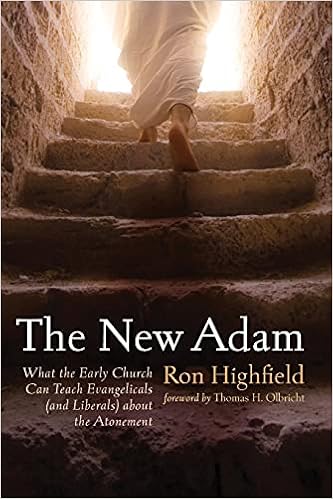
As readers of this blog know I recently published two books, Rethinking Church and The New Adam: What the Early Church Can Teach Evangelicals (and Liberals) About the Atonement (Cascade, 2021). Although I felt compelled to write and publish those books and I believe they are worth reading, I have a hard time feeling good about promoting them. Part of my hesitancy arises from imagining that other people might view me as promoting myself, seeking honor, or placing myself above others.

This fear was reinforced about a week ago. I posted a link to the Amazon.com page for The New Adam to a FB group to which I belong. (It is important that you know that this is a church group.) One person commented on the link something like this:

“I wish people would stop trying to sell their Bulls…ty books to this group.” [BTW to protect this person’s identity, I’ve deleted the original post and all subsequent comments.]

What do you say to a comment like this? I said something like this:

“I did not know bulls…ty was a biblical term. Perhaps, even if you read my book you would still think that it is bulls…ty, but surely you cannot know this before you read it.  I wonder what you want from authors and teachers. Should they cease writing and speaking and hide their thoughts from the world for fear that someone will think they are merely seeking attention or placing themselves above others? I think about all the great books I’ve read and how much I appreciate the labor that went into them and the insights I received from them. Indeed, no human being is without sin. Everyone loves honor and enjoys attention, and no author’s heart is entirely pure. But isn’t too cynical to judge the work of every author, speaker, and teacher—even when you have not studied their works—as exclusively self-aggrandizement?”

I agree that there are too many books. Libraries are full of them, and millions more are printed every year. Many of them repeat what has been said hundreds of times already. Most do not grab my attention. With rare exceptions, I read only the best books I can find on whatever issue I am thinking about at the time.

Why then do I write more books and essays? Is it because I need attention and confirmation? Perhaps this is a factor; I won’t deny it. But there are other reasons as well. When I was a young person I had many troubling questions. I needed answers. I asked my teachers, and I searched in books. Within my circle at that time I found no one who could help. And there were so many books in the library I did not where to start. Soon realized that to make progress I had to think through problems for myself, and I discovered that the best way for me to do that was to write. I also discovered through experience that other people could benefit from my work of thinking and writing.

What drives me to write and publish, besides the need for attention and affirmation? I want to understand my Christian faith insofar as I can and I believe that helping others to understand is one of the best things I can do for them.

Do I believe that by thinking about the issues surrounding the atonement I have achieved greater insight into my faith in Jesus Christ and the salvation he offers? Yes. I do. Do I want you to read The New Adam? Yes. I do. Do I want you to tell others about it? Yes…because I want them see what I have seen and experience what I have experienced. I pray the Lord will forgive me for my less noble motives. And if there is any bulls…t in my books I pray that my readers will forgive that as well.

Note on the definition of B.S.: In his famous essay “On Bs…t,” Harry Frankfurt defines this mode of speech as focused not primarily on truth, as the liar and the truth teller are, but on conveying a favorable impression about the speaker to the audience. One who speaks this way carelessly blabs confidently about things he does not really understand (Princeton: Princeton University Press, 2005).  

Was Jesus Punished for Our Sins?

From the Publisher:

Have you ever found yourself repeating expressions such as “”Jesus saves”” or “”Jesus died for our sins”” without really understanding them? When popular speakers “”explain”” how Jesus’s death satisfied God’s wrath so you could be forgiven, do you ever think to yourself, “”I don’t get it””? If so, you’re not alone, you’re not dumb, and the problem is not with you. Ron Highfield reframes Christian teaching about the atonement so that it comes alive with fresh meaning. Drawing on biblical and traditional sources, Highfield explains why our frustration in trying to understand how Jesus’s death satisfies God’s judicial wrath is inevitable . . . because the idea doesn’t make sense and the Bible doesn’t teach it! Instead of viewing the atonement as the solution to God’s problem of how to forgive sins while remaining perfectly just, Highfield argues that the atonement is God’s solution to our problem. In Jesus, God rewrites the human story, forgiving our sins, correcting our mistakes, and realizing our destiny. As one of us, Jesus lives a perfect life, passes through death, and enters into eternal life. As the new Adam, he invites us to join his family, share his life, and enjoy his victory

How Does Jesus Save?

After six years of work my book on the atonement The New Adam is finally in print. I hope you will check it out and recommend it to others. We often repeat such statements as “Jesus saves” or “Jesus died for our sins” without understanding what they mean. Perhaps we think we don’t need to understand. However I believe that the first Christian believers understood, and I believe we can also understand. This book will, I believe, deepen your understanding of how Jesus saves and what salvation means. I will be blogging for the next few weeks on some ideas from this book.

At the time of this post the preview link is not working. Go directly to Amazon.com and search for Ron Highfield, The New Adam.

The Wisdom of Epictetus and the Culture of Blame

Who doubts that we live in a culture of blame? Whatever you suffer, whatever you do, whatever emotions you feel, whatever you lack is someone else’s fault. If you are poor, sick, or uneducated; if you are unhappy, unsuccessful, and don’t get the respect you think you deserve, and if these things make you angry, resentful, jealous, envious, and hopeless…fate, other people, society, government, or God is to blame.

Epictetus (AD 50 to 135) was a stoic philosopher who suffered greatly in life, as a slave, under torture and abuse, and through sickness and banishment. His thoughts were collected and published by a disciple and translated into English as Discourses. I have long admired Epictetus’s thoughts but only recently have I read straight through Discourses. Like other Stoics, Epictetus believes that everything that happens in the world of appearances happens by necessity. We have no control over what merely happens to us. Hence to fret, worry, rage, or despair over the appearances and their impact on us makes no sense. We don’t control them, can’t prevent them, and can’t change them.

According to Epictetus, the only thing we control is our inner self, which is free from the necessity that determines the course of external events. No one and nothing can make you feel or do anything against your will. If you feel anger, resentfulness, jealousy, envy, self-pity, or despair, you choose to do so. You control what you do in response to every situation. If you betray your friends or curse God because someone threatened to drive a sword through your heart, you cannot blame the threat for your sin. You chose to value your life above faithfulness or piety. You are responsible for what you do no matter what choices nature, fate, and other people place before you.

What does Epictetus’s wisdom have to say to the culture of blame? We do not have to accept the Stoic view that everything in the world of appearances happens by necessity in order to acknowledge that we do not control what happens to us. We control only what we do in response. You don’t have to be a Stoic to understand that no power can force us to choose what we do not will or do what we don’t want to do.

Clearly, Epictetus understood that we are not always responsible for the external circumstances that affect us. The forces of nature and the actions of other people often affect us negatively. So, you do not have to take on guilt for circumstances over which you have no control. Hence much of the suffering we endure can be “blamed” in a certain sense on external forces. But only objectively. That is to say, external circumstances are responsible for much of the bodily suffering we must endure. The culture of blame, however, becomes pervasive when we habitually blame external circumstances for our unhappiness and sins. In other words, we refuse to take responsibility for our free choices and place the blame on something else, pretending that we have no control over our inner selves. This endemic denial of responsibility for our actions is what I mean by the culture of blame. Everyone is oppressed, deeply offended at any slight, awash in self-pity, always looking for someone to blame. And indeed you may have to deal with harsh circumstances, but Epictetus and Jimmy Buffet agree: if you are unhappy and “wasted away again in Margaritville, “it’s your own **** fault.”

New Anti-Institutionalism

I’ve been searching for a term that captures the mood that has gradually come over me in the last ten years. I think I’ve found it: New Anti-Institutionalism. I sense that this mood has become widespread among American Christians and has developed into something of a grass roots movement. But why “new”? How does it differ from “old” anti-institutionalism?

Old Anti-Institutionalism

For readers that don’t know my background, my theological and ecclesiastical identity was shaped in the (American) Stone-Campbell Restoration Movement, out of which came the Disciples of Christ, Independent Christian Churches, and Churches of Christ. Among Churches of Christ there developed an anti-institutional tradition that resisted the rise of parachurch institutions that accompanied the increasing wealth, urbanization, and the social and missionary consciousness of churches after the 1880s. Many argued that these organizations were usurping the work that churches ought to do. Parachurch organizations may do good works in Jesus’s name, but they don’t answer directly to the authority of the church. Indeed, some feared that local churches would be brought under the authority of such organizations. I am sure that some Baptist and other independent churches also had similar fears and engaged in similar controversies. In Churches of Christ, the original anti-institutionalists argued that the local church was the only institution with divine authority to carry out such essential works of the church as preaching the gospel, sending out missionaries, and taking care of the poor. The cogency of such arguments depended on the widely accepted doctrine of the church known as restorationism. Restorationism is the idea that many of the divisions among Christians are caused by adding extra features to the simple organization of the New Testament church. However, following the simple pattern of the New Testament church, without addition or subtraction, charts the way both to faithfulness to Scripture and unity among believers.

New Anti-Institutionalism

The new anti-institutionalism does not object to the existence and work of parachurch organizations, certainly not for the reasons given by the old anti-institutionalists. We cannot discern one organizational pattern in the New Testament that must be implemented regardless of era or circumstances. Nor are we concerned with legal precision of organization. We worry, instead, about our freedom to preach and live the gospel in this post-Christian culture. The challenge to our spiritual freedom comes from within as well as without the church. Hence new anti-institutionalists focus as critically on institutions that call themselves churches as they do on so-called parachurch organizations. In fact, new anti-institutionalists consider most traditional churches to be “parachurches.”

Note: See my book Rethinking Church: A Guide for the Perplexed and Disillusioned (Los Angeles: keledei, 2021) for my explanation of why most churches are really parachurch organizations. One suspicious critic seem to think of Rethinking Church as an apology for old anti-institutionalism. Not really, but I suppose one could think of it as a manifesto for New Anti-Institutionalism.

The Regulatory State

In nineteenth-century America, the dominant culture was friendly toward Christianity, there was no income tax, and no regulatory state. Churches and parachurch institutions had great liberty to organize and conduct their affairs as they please without government entanglement. In 2021, however, churches, schools, and all other legally recognized associations live under mountains of laws and government regulations. Their freedom to preach and live the gospel is under constant threat. Compromise and assimilation are their greatest temptations. The new anti-institutionalists assert that the threat from the regulatory state and the dominant culture has become so menacing and compromise so common that it has become impossible for a government approved institution to remain unequivocally faithful to the gospel. We don’t trust any of them.

The Impersonal Institution

Institutions are by nature fictitious persons. They have no heart or soul. They are organized as bureaucracies and operate according to rules. The bigger they grow the less nimble they become.  Self-preservation is their strongest instinct. The institution’s officers and bureaucrats almost inevitably substitute their own private interests for the founding goal of the institution. And when that institution calls itself a church, it often prioritizes such institutional goals as growth in numbers, visibility, and wealth, over the spiritual welfare of individual believers. The institution is well fed while its members starve. New anti-institutionalists object to institutionalization because it is the enemy of community and individual discipleship to Jesus.

Agility, Simplicity, and Freedom

New anti-institutionalists are not iconoclasts. We don’t want to demolish institutions for the joy of hearing the crashes and bangs. We want believers to be free in mind and heart to invest themselves directly in service to God without bureaucratic rules, government entanglement, and avoidable cultural pressure to assimilate. New anti-institutionalists prize agility, simplicity, and freedom—all for the sake of the gospel of Jesus.

Politically Correct Christianity

One of my Chinese students recently asked me whether Christianity would eventually become a philosophy instead of a religion. The question puzzled me at first. After some probing, I realized that he was asking whether Christianity would eventually drop all references to the supernatural world, sin and forgiveness, death and the devil, and the eternal destiny of human beings and become a simply another source of wisdom alongside Confucianism for living the present life. This young man lives in an officially atheist country, so perhaps he was thinking that a Christianity understood as ethical wisdom would not be as offensive to the ruling party as a Christianity that referenced God and the Lord Jesus Christ. Its ethics could inspire personal well-being, community spirit, and social peace. Such a Christianity could be made to fit with a culture focused only on this world, and with a little adjustment here and there it could even lend support to the social and economic goals of Chinese communism.

Even before our conversation ended my mind had turned from the atheist culture of China to the western world, specifically to the United States of America. I am not going to generalize, but more and more I find myself interacting with Christians who focus on Christianity’s utility as an instrument for “social justice” to the near exclusion of its message of salvation from sin, death, and the devil. The question seems no longer to be “how do we attain right standing before God as individuals?” but “what position should we take on the social issues of the day?” It is all about problems of race, gender, inequity, and climate change. Its ethical message is limited to diversity, equity, and inclusion. The world is divided into oppressed and oppressors, innocent and guilty, anti-racists and racists rather than believers and unbelievers. Sin is a systemic problem within the social order, and salvation can be achieved only through social change. My Chinese student asked about a politically correct Christianity suited to an atheist culture. I was shocked when I thought of the parallels to the American situation. Some people prefer a politically correct Christianity that requires no personal repentance and conversion and is adapted to the secular progressive spirit that dominates high culture. It is a Christianity without power, a timid echo of the culture, whose most potent message to the world is “we can be progressive too.”

The original Christianity presented itself as the solution to our deepest problems. And our deepest problems are not political, social, or psychological. They are sin, death, and slavery to the devil. All other ills derive from these causes. Sin is the radical, individual self-centeredness of the soul that pollutes every act in the mind and in the world. Social problems find their origin in the original sin in the human heart. Without God’s intervention, death is the final destiny of every living thing. If nothing lasts, nothing matters; and death is irrefutable proof that nothing lasts. The devil is that deceiving and enslaving power that manifests itself in the individual evil will, in the lust of the flesh, lust of the eye, and the pride of life and in social life in injustice, war, and genocide. It is a power against which no flesh can stand. Christianity is about salvation from that total destruction of body and soul that is the human heritage and destiny. Politically correct Christianity offers no remedy for sin, no salvation from death, and no victory over the devil. It is a physician that treats the symptoms but neglects the disease.

Rethinking Church–Just Released

I am excited to let you know of the release of my new popular level book Rethinking Church. Some of you followed my 2020 series “Rethinking Church” in which I developed many of the ideas that now comprise this book. I hope you will go the Amazon page and read John Wilson’s Foreword to the book and my Preface. Perhaps you will think of people who would be encouraged and challenged by reading this book. It has questions for discussion at the end of each of its seven chapters and would serve well for small group discussions. I also believe church leaders need to consider my criticisms of churches that continue “business as usual.” And I present a different and much simpler vision of church life.