Category Archives: Christian Theology

Theological thoughts written for interested non experts

Divine Joy and Joy Divine: Five Points on Creation

We tend to treat God’s act of creating heaven and earth as an event in the long past, relevant to our lives only as setting the stage for the drama of sin and salvation. But the biblical doctrine of creation is much richer than that. It brims with implications for daily life and for understanding God’s continuing relationship to us in providence and in salvation. The first two chapters of my book The Faithful Creator explore the biblical doctrine of creation, summarizing it in five points. In today’s post I want to state these points and briefly explain them.

(1) The one God is the absolute origin and sovereign ruler over all that is not God. “In the beginning God created the heavens and the earth” (Genesis 1:1). Paul states this truth in unforgettable words: “For from him and through him and to him are all things” (Rom 11:36; cf. 1 Cor 8:6). The two concepts of absolute origin and sovereign ruler go together. Our creations can get away from us and outlive us, but that is because we are not “absolute” origins for the things we make. Nothing escapes the Creator. And that is very good news for those who love the Creator and believe he is good!

(2) The one God freely established the Creator-creature relation, which is characterized by generosity, freedom, and power on the Creator’s side and dependence and debt on the creature’s side. God was, is and always be our Creator. We will always depend on the Creator and will be forever in his debt. For some, this type of relationship seems demeaning, and they wish to forget it or try to escape it. But those who understand that the one on whom we depend is the Father of the Lord Jesus Christ revel in the gracious gifts of our faithful Creator.

(3) The creation really exists before God and stands before him as good; that is, as the result of God’s act of creation, the creature really is what God intended it to be. In the first chapter of Genesis, God pronounced the creation good at almost every point. And the Psalmist exclaimed, ‘The earth is the Lord’s, and everything in it’” (Ps 24:1). And Paul explains, “For everything God created is good, and nothing is to be rejected if it is received with thanksgiving” (1 Tim 4:3-4). That creation is “good” does not mean that it is perfect or that it cannot be misused. Rather it means that each and every creature has a place and a function rooted in the will of the Creator. Christians are not Gnostics or Manicheans who reject the body, food and the human joys of life. The good things of creation may be legitimately used to sustain and enhance human life and bring glory and thanksgiving to God. Only, they must not be worshiped or enjoyed selfishly or greedily. Instead they are meant to provide occasions for shared joys. Jesus did not condemn feasting but he did urge us to invite the poor and the sick that they may share in the joy!

 (4) The Creator-creature relation established at the beginning, with its characteristic qualities, endures for all time. The author of Revelation praises God in these words, “You are worthy, our Lord and God, to receive glory and honor and power, for you created all things, and by your will they were created and have their being” (Revelation 4:11). God sustains his creation through the powerful word of the Son (Hebrews 1:3). Creation is happening now. Every new moment and every new thing comes from the hand of the Creator. What a difference it would make in our sense of God’s presence if we grasped this truth! The world and everything in it, every beat of our hearts, every breeze that cools our brows, and “every good and perfect gift” (James 1:16-17) comes from the heart of our faithful Creator!

 (5) Human beings possess a unique relationship to the Creator characterized by their image and likeness to God and responsibility to him. Human beings are not the whole of God’s creation but they have been given a special role. We have been given the capacity to know and love the Creator, and we have the obligation to image the Creator in the created world. Of course we don’t do a good job of it. In the New Testament we learn that Jesus Christ is the image of God in an archetypical sense: “The Son is the image of the invisible God, the firstborn over all creation” (Col 1:15; cf. 1 Cor 15:49). By living in fellowship with the true image of God in the power of the Spirit we can begin to do what Adam did not, that is, shine with the glory and image of God (Col 3:10; 2 Cor 4:4; Rom 8:9) and spread the divine light over the world. Let there be light!

Creation: The Most Neglected And Underrated Teaching In Contemporary Christianity

I am very excited to announce the publication of my book The Faithful Creator: Affirming Creation and Providence in An Age of Anxiety (InterVarsity Press, 2015). I got my first copies Tuesday, September 15. I have more I want to say about the church, but in view of the arrival of the book, I want to focus on doctrines of creation and providence for the next few weeks.

Christianity affirms that the God we see in the face of Jesus Christ and experience in the power of the Holy Spirit, is the Creator of all things. The first words of the Bible are, “In the beginning God created the heavens and the earth” (Genesis 1:1). Paul reminded the believers in Corinth to be careful to avoid idolatry. There are many “so-called gods and lords” out there in the culture, “yet for us there is but one God, the Father, from whom all things came and for whom we live; and there is but one Lord, Jesus Christ, through whom all things came and through whom we live” (1 Corinthians 8:6:). And the first declaration of the Nicene Creed (381) affirms: “I believe in one God, Almighty; Maker of heaven and earth, and of all things visible and invisible.”

Considering its foundational importance and its comprehensive scope, the Christian doctrine of Creation may be the most neglected and underrated teaching in contemporary Christianity—and the most hated by those outside. In the first paragraph of Chapter 1 of The Faithful Creator, I underline the importance I see in the doctrine of creation:

“Learning how a thing began tells you much about how it will end and the course of its journey. In our experience everything begins from nothing and returns to nothing. From dust to dust, sunrise to sunset, in the end everything returns to its beginning. And if our origin really is nothing, our end will be nothing as well and our story a meaningless tale. But the Bible’s story does not begin with nothing, and it does not end with nothing. It begins and ends with God. And because God is our beginning and end, our journey will not be meaningless, for God surrounds and enfolds our time in his eternity. God alone is our origin and our creature-relationship to God defines our essence, and this makes the study of divine creation supremely relevant to our existence” (p. 25).

Taking creation and the Creator seriously can transform the way you feel about the world around you and your own existence. And taking the faithfulness of the creator seriously by coming to embrace the doctrine of God’s all-embracing providential care, can begin to liberate us from the pervasive anxiety that robs us of the “peace that passes understanding.” These are the reasons I wrote this book.

You can look at the Table of Contents or browse sections or purchase the book at Amazon.com or other online sites:

http://www.amazon.com/Faithful-Creator-Affirming-Creation-Providence/dp/0830840826/ref=sr_1_4?ie=UTF8&qid=1442619010&sr=8-4&keywords=ron+highfield

Next Post to Follow Soon: “Why Contemporary Culture Hates the Christian Doctrine of Creation”

What is the Church? Building, People, Event or What?

“The church is not the building, and the church is not an idea. The church is not merely the clergy. The church is the people!” Perhaps you have heard words to this effect. True, the church is not the building. Employing the word “church” to refer to a house of worship makes sense only because the church meets there; it’s not the primary meaning of the word. The church is not merely an idea but an actual thing. But is the church merely the people?

No, it cannot be merely the people because in that case any gathering of people would be the church. To be the church, the gathered group must at least be people of Christian faith and be gathering for the purpose for which the church meets: praying, hearing Scripture read and expounded and, most centrally, participating in the Lord’s Supper or the Eucharist. Well then, does the church exist only when Christians gather to participate in the Eucharist? No, for then the church would be merely a periodic event the people engage in rather than a reality that encompasses their whole persons all the time. Surely the church exists even when it is not gathered and visible.

How can the church be a reality even when it is not gathered and visible? And why is this important? Most references to the church in the New Testament refer to the Christians in a particular locality whether gathered or not. But the letters to the Ephesians and the Colossians refer to the church as the “body” of Christ (Ephesians 5:23, 30 and Colossians 1:24). Paul speaks of how Christ “feeds and cares” for his body the church like we feed and care for our bodies (Ephesians 5:29). The relationship between Christ and the church is a “profound mystery” (Ephesians 5:32).

Paul speaks of individual Christians as having been “baptized into Christ” (Romans 6:3 and Galatians 3:26). Christians are “in Christ” (Romans 8:1; and many other places) and “have the spirit of Christ” (Romans 8:9). Christ is “in you” (Romans 8:10) and you are “in Christ” (Romans 8:34). Just as a physical body has many parts but is one, “in Christ we, though many, form one body, and each member belongs to all the others” (Romans 12:5). We are “united” with Christ (Philippians 2:1-2). In the Lord’s Supper or Eucharist, we “participate in the body and blood of Christ” (1 Corinthians 10:16).

What, then, is the basis of the existence and the unity of the church even when it is scattered over a city or the whole world or meets under different denominational names? Of course, the answer is Jesus Christ with and in and through the Spirit of God. Everyone who has been baptized into Christ has been united to him. And in him all are united to each other as the church. The church, then, is the people of God gathered together in Christ through the Spirit. They are always together in Christ, but they long for the visible gathering where they can express their faith in Christ and love for each other.

Though the church is always one, holy, catholic and apostolic in Christ, and it exists in full actuality in him, the spirit of Christ drives us together so that we can experience that reality with our eyes and ears and hands. Just as Christ became incarnate in a physical body in Jesus of Nazareth to help us in our weakness, he draws us together to participate in the Eucharist, in prayer and in hymns so that we can touch, taste, and hear him in our time and space. The church is his body, and in it he speaks in audible voice and comforts with physical touch.

So it does not matter how small a church you attend or in what corner of the planet you gather. Christ is there, and where he is, there is also the whole church–the one, holy, catholic and apostolic church. And I too am there with you, my brothers and sisters.

The Politics of Jesus

Did Jesus have political aims? Of a certain kind, yes. Let’s talk about it.

In his book Politics, Aristotle wrote:

“Hence it is evident that the state is a creation of nature, and that man is by nature a political animal. And he who by nature and not by mere accident is without a state, is either above humanity, or below it; he is the ‘Tribeless, lawless, heartless one,’ whom Homer denounces—the outcast who is a lover of war; he may be compared to a bird which flies alone.” (Book 1.2.9).

Human beings are endowed with reason and speech, and these powers cannot be brought into full actuality apart from human community. Human nature is so rich that it cannot be realized fully by one individual, but when many people over centuries contribute their gifts, each individual can enjoy the work of all. The products of reason and speech become common property and enrich everyone. In the first paragraph of Politics, Aristotle made this significant claim: “If all communities aim at some good, the state or political community, which is the highest of all, and which embraces all the rest, aims, and in a greater degree than any other, at the highest good” (1.1.1).

Aristotle grounds the state in human nature. A being that is stateless by nature is either a god or a beast. The political order encompasses all other communities within its sphere. Unlike subordinate communities, it aims “in a greater degree than any other, at the highest good.” A family, a guild or a school will aim at the welfare of its members, a partial good. The state aims at the welfare of everyone, so that everyone may enjoy to the fullest degree the full flowering of human nature.

Let’s compare and contrast Aristotle’s thinking about the political community with the New Testament’s teaching about the church. Surely Aristotle is right that the state is an outgrowth of human nature and that a being stateless by nature is not human in the ordinary sense. The church is a human community, and Aristotle would number it among those subordinate communities that aim in a less comprehensive way at the highest good. But Christianity understands this community to be composed of a “new humanity,” “born again,” a people endowed with the “Spirit of the living God” and having under gone “the transforming of their minds.” They are in Aristotle’s words “above humanity.” A divine power is at work in the church to raise it above normal human life.

Aristotle is also on target when he asserts that every community aims at a good that gives it purpose, unity and identity. However, Aristotle’s “highest good” is limited to this world, this life. Christianity asserts that human beings should aim at a goal higher than the common good of the whole community within this life. God created human beings in the image of God, and human nature, empowered by the grace of the Spirit, can participate in the divine nature and attain eternal life. From Aristotle’s viewpoint, the church’s aim is off target; it aims too high and it demands too much of mere mortals. It is bound to fail.

The New Testament presents the church as the community founded by Jesus Christ. It is indwelt and empowered by the Holy Spirit and directed to God the Father. In analogy to Aristotle’s view of the state, the church is based on the nature of the new humanity and is necessary for the full flowering of this new human being. Christians are not “birds that fly alone,” but they really do fly. The Christian is not only a human being endowed with reason and speech but also someone united with Christ, who dwells in heaven and yet fills the universe. The Christian has received the life-giving Spirit and has been freed from the power of sin and death. Unlike Aristotle’s natural human being, the Christian lives by faith and not by sight.

The church is the community whose threefold purpose is (1) to enable the new powers and virtues that have been given to believing and baptized human beings to come into full use and benefit the whole church and through the church the whole world; (2) to embody as far as possible in the present the perfect community of heaven, the Father, Son and Spirit and the coming Kingdom of God, which is the union of human beings and God in the perfect divine/human fellowship; and (3) to call the whole world to rise up not only beyond the beastly nature of the stateless one, the ‘Tribeless, lawless, heartless one.’ It also calls human beings beyond the best political order human beings can create. She serves the whole human race by calling it to its final destiny and revealing its true dignity.

Hence to normal human beings, Christians will always appear to have their heads in the clouds. Their values are a bit askew. They are always rejoicing but never take pleasure in evil. They are serious about everything but in despair over nothing. The Christian is as courageous as a lion but as gentle as a lamb; they have wills as hard as steel but hearts as soft as wax.

The church will never subordinate itself to the political community because the good it seeks is higher than the good sought by the state. The virtues she promotes—love, faith and hope—are better than those the state values. She seeks heaven while the state grasps at earth. The state is built on violence and coercion, and it seeks wealth, power and worldly security; the church is built on freedom and love and seeks treasure in heaven. The church is the temple of God, the city of God, the body of Christ. The state is human nature writ large, with all its strengths and weaknesses.

For Aristotle, human beings are “political animals” whose destiny is achieved, if at all, only in this life. For Christianity, human beings are more; they are ecclesiastical animals whose destiny lies in eternity, in the divine life.

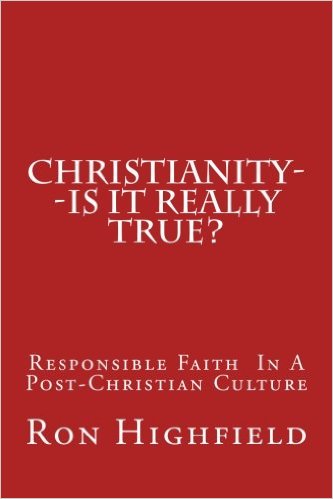
ANNOUNCING the publication of “Christianity–Is It Really True? Responsible Faith In a Post-Christian Culture”

I am excited to announce the publication of the book that includes 48 revised and edited essays from last year’s series “Is Christianity True?”

Perhaps you know an undergraduate or graduate student who could benefit from reading it. Perhaps you want to lead a small group on this theme. Perhaps you simply want a copy for yourself.

If you enjoyed the series I hope you will recommend the book to your friends. I set the price near the minimum allowed by Amazon.com, $8.95.

It is available also in Kindle. $3.49.

Read the PREFACE, which describes the contents and aims of the book:

Preface

This book is second in a series of books I’ve written in weekly installments on my blog ifaqtheology (Infrequently Asked Questions in Theology). It contains in revised form the 48 essays I wrote between August 2014 and July 2015 on the question, “Is Christianity True?” I hope that publishing them in printed form will make them accessible to individuals and groups that want to study the topics of Christian evidences and Christian apologetics. I have long felt that the most popular works on evidences and apologetics don’t quite get it right. As a whole they try to prove too much and do not take adequately into account our fallibility. They underestimate the role of the will in belief. And they too readily accept the burden of proof, which puts the case for Christianity at a decisive disadvantage. They do not take the best logical and rhetorical path from nonbelief to full Christian faith. Specifically and most disturbingly, they attempt to prove the Bible’s authority independently of faith in the resurrection of Jesus Christ from the dead. In this book I develop a different understanding of the path to faith, a different vision of the role of the will in belief and a different way of establishing the authority of the Bible.

Part One sets out the ground rules for Christian evidences. The chapters in this section will clarify the purpose, methods and limits of evidences. We will ask who bears the burden of proof and what conditions must be present before an inquirer can make a reasonable judgment to believe the Christian gospel and a responsible decision to take up the Christian way of life. We define such relevant terms as truth, reality, certainty, knowledge, faith and opinion. Finally, we will map the path from nonbelief through four decision points to full Christian faith.

Part Two takes us through the four decision points we must traverse on our way to full Christian faith. First, we must decide between atheism and belief in God. I argue that this decision depends on our choice between matter and mind as the most fundamental explanation for our world. Is the beginning and end of all things spirit or matter, life or death, intelligible or unintelligible, mind or machine? Having decided that believing in God is the most rational choice, we now confront the second decision point where we ask, “Is the mind that is evident in the intelligible order of the world impersonal or personal?” If we opt for a personal God, a third decision point confronts us with the choice between thinking of God as the highest aspect of nature or as transcendent over nature. Is God supernatural or natural? Is the world God’s creation or God’s body? The issue can also be framed as a decision between theism and panentheism, which is the idea that God is an aspect of the world neither wholly different from world nor fully identical to it. If we accept theism as the best answer to this third question, we come to the fourth decision point at which we must decide whether to remain mere theists or move into full Christian faith. At this crossroads we are required to discuss the possibility and actuality of a revelation of God in history. At the moment of decision we must assess the evidence for the bodily resurrection of Jesus Christ from the dead and reflect on the meaning of this event for the nature, identity and significance of Jesus.

Part Three marks the transition into a new phase of the argument for Christianity’s truth. The previous chapters presented an affirmative case for making a reasonable judgment for Christianity’s truth and a responsible decision to become a Christian. But now we must deal with some misunderstandings and objections to Christianity. The positive side of the argument is often called “Christian Evidences” and the defensive side is often called “Christian Apologetics” or “Defense of Christianity.” The necessity of the defensive phase of the argument rests first on the propensity of people to misunderstand what Christianity actually is and what it really teaches. How can we make a reasonable judgment or a responsible decision about Christianity unless we possess an accurate understanding of its teachings? Some people find certain versions of Christianity incredible or morally offensive or insufferably superficial, and hence hesitate to accept them. Others adopt a form of Christianity that is defective when compared to the original form taught by Jesus and the apostles. It is questionable whether one has really made an authentic decision about Christianity if the form they know is not the real thing.

The second reason for the pursuing the defensive phase of the argument arises from the barrage of objections that nonbelievers hurl against Christianity. Some raise objections to the existence of God, theism or divine revelation. They raise the problem of evil or assert that the world needs no explanation beyond itself. Others object to the moral teachings of the Bible or deny its historical accuracy. Some offer objections to the reliability of the apostolic witnesses to the resurrection of Jesus or object to the very possibility of miracles. The list is endless. And even if one thinks the case I made in the first phase of the argument is very strong, one may still be disturbed and caused to doubt by the many objections that are raised. Hence I want to reply to some of the most potent objections. Some of these objections may turn out to be based on misunderstandings of Christianity. But some may accurately represent Christianity and yet still suggest reasons to doubt or reject it.

How to Read This Book

I wrote this book as a sustained and step-by-step argument, and reading it from beginning to end may be the best way to get the most from it. But I think there are several points at which readers could enter the argument without getting lost. If you are not interested right away in the question of methods in apologetics, you could skip Part One and move directly to Part Two, which develops the four decision points on the way to full Christian faith. And even within Part Two, you could read the chapters on the fourth decision point, which focuses on the resurrection of Jesus Christ, without reading the first three. Or, you could begin with Part Three, which deals with objections to Christian faith. No matter where you begin, I hope you will read the whole book so that you can see the big picture argument.

There’s Nothing Mere About “Mere Christianity”

Last week I announced the theme for the coming year: “A Catechism of Mere Christianity for a Post-Denominational Church Living in a Post-Christian Culture.” I explained the rise of the post-denominational church and its negative effect on contemporary churchgoers’ understanding of the Christian faith. Today I want to explain what I mean by “mere Christianity” and why the church’s teaching must take into account the general post-Christian Culture.

I am sure that the term “mere Christianity” reminds many of you of the book by C.S. Lewis. In his preface, Lewis cites the Puritan pastor and theologian Richard Baxter (1615-91) as his source for the term “mere” Christianity. In Baxter’s Elizabethan English, “mere” meant pure, unadulterated or unmixed, whereas in modern English it has acquired the connotation of minimal or bare. In Mere Christianity, Lewis attempts to present the central teaching common to almost all denominations, Protestant and Roman Catholic. According to Lewis, nonbelievers ought to be given an opportunity to hear the basic Christian message rather than having to sift through all the fine points of denomination-specific teachings.

Perhaps Lewis wishes for his age what St. Vincent of Lérins (early 5th century), advocated for his, that is, that Christians ought to give special honor to “that which has been believed everywhere, always and by all.” Lewis discovered that it is not easy to articulate “mere” Christianity in a way satisfactory to everyone any more than the Vincentian rule can generate a list of teachings acceptable to everyone. Lewis’s first readers found matters with which to quibble and some later readers cite omissions and offenses. But Lewis’s work has stood the test of time. Seventy-years later it is the number one selling book in the category of theology and is read approvingly by Protestants of all denominations and Roman Catholics.

In this series, however, I will not attempt to imitate C.S. Lewis. His book was aimed at outsiders and was written before the post-denominational church gained the prominence it holds today. This series aims at insiders and takes our post-denominational consciousness into account. This is why I am referring to it as a catechism. Seventy-five years ago, during the Second World War, when Lewis first presented the material contained in Mere Christianity to a British radio audience, it would have been inaccurate to refer to England as a “post-Christian” culture. Not so today, for Great Britain or the United States. Lewis could presume that regular churchgoers have been taught the basics of the faith by their denominations. We can no longer make this presumption. Hence my title “a catechism of mere Christianity.”

Like Lewis and St. Vincent, I am convinced that there is a set of basic beliefs that defines the boundaries of Christianity and that the historic traditions (Orthodox, Roman Catholic and Protestant) share this core. Perhaps the exact boundaries are fuzzy, and it would be difficult and perhaps impossible for these traditions to agree on a particular text articulating these basic beliefs. Nevertheless when I read the Seven Ecumenical Councils (or at least the Nicene Creed), the Protestant confessions of faith and catechisms, the documents of the Second Vatican Council and the Roman Catholic Catechism, I am amazed at the consensus on these core beliefs. And I am also amazed at how extensive the list of consensus beliefs and practices is. There is nothing minimal about this “mere Christianity”!

Though the post-denominational culture in its evangelical form does not deny those historic beliefs and practices, it neglects to teach them in their fullness and focuses instead on experience. The language of worship includes references to God, Jesus and the Spirit. It directs worshipers to praise the grace of God, the love of Jesus and the joy of the Holy Spirit. Sermons inspire and encourage individuals. But as far as I can tell, there is little instruction in doctrine. Such neglect fails on two counts. (1) It assumes either that Christians don’t need instruction in the material covered in the historic catechisms or that they already know it. My experience is that they do not know this material, and my conviction is that they really need to know it. (2) It assumes that churchgoers understand the few beliefs that are mentioned in worship and sermons. I do not believe this is true. Familiar religious language has a way of losing its cognitive content and becoming opaque unless it is explained continually. When this happens, Christian words or professions of faith cease to direct the mind and become mere expressions of religious emotions.

In this series I plan to remind you of what your church should be teaching all its members (catechism) about basic Christianity (mere Christianity). All along, we will keep in view Christian language’s loss of meaning for a post-Christian culture.

Most church catechisms follow the order of the creed or of that church’s confession of faith. That order corresponds also to the order of most systematic theologies: God, the Trinity, creation and providence, the fall and sin, Christ and salvation, the Church and the Spirit, the Christian life and eschatology. I shall begin at a different place, with the church. And next week I shall explain why I begin there.

Next Week: “Yes, The Church Really Is Our Mother.”

A Catechism of Mere Christianity for a Post-Denominational Church Living in a Post-Christian Culture

Happy New Year! Today marks the beginning of the third year of ifaqtheology! And my new theme is announced in the title of today’s post.

I suppose it’s always been a problem, but it seems to me that the average churchgoer in the United States (elsewhere too I am sure) is becoming less and less familiar with the full range of Christian teaching. I don’t intend to quote surveys and studies of this phenomenon. It’s just an impression, and I will work with that. Few observers would question the assertion that denominational loyalties and confessional identities have declined dramatically in recent years. And we see evidence every Sunday that contemporary churches place less emphasis on teaching, learning and remembering than on the “worship experience” in which one expects to feel joy in the presence of the transcendent. Experience has moved from being considered a by-product of the encounter with word and sacrament to the central goal of Christian gatherings. Has thirst for experience replaced desire for understanding or has loss of understanding leading to greater thirst for moving experiences? Is the loss of confessional and denominational loyalties the cause or the effect of the loss of teaching and learning? I suspect they are interrelated in ways too complicated to describe.

At least since the early 19th century, American Christianity has been expressed, lived, taught and learned in a denominational form. Denominational bodies competed for the minds and hearts of people by touting the strengths of their particular package of teaching and church life. (Undoubtedly, social location also has a huge impact on which denomination one chooses.) Denominations for the most part are confessional bodies and have an interest in teaching the full range of their doctrine to prospective converts, new converts and children. As long as denominational or confessional consciousness is strong the task of teaching doctrine will be high on the agenda of a church’s priorities. The disadvantages of denominationalism—as opposed to an established, territorial church—are the presence of multiple contradictory voices all claiming to represent Christianity and the animosity created by such division and competition. But one positive thing that derives from the denominational and confessional form of Christianity is that most members of such Christian bodies receive the full range of doctrinal instruction; doctrinal teaching is important to these bodies, if for no other reason than to reinforce denominational loyalty.

In the present environment, with denominational loyalties at historic lows and confessions of faith gathering dust on the pastors’ shelves, churches have lost a major incentive to teach the full range of doctrine. To the contrary, church leaders deemphasize doctrine to broaden their appeal to prospective members. Taking the most generous interpretation of this practice, the goal is more effective evangelism. A less generous interpreter might conclude that growing a big church has become an end in itself. The consequence of this development is disturbing: the people don’t get taught at all! Hence the appalling ignorance of churchgoers, lay church leaders and even clergy in contemporary churches. Surely ignorance cannot be a means to any good end! But many evils befall the untaught.

We need a catechism of mere Christianity for a post-denominational church living in a post-Christian culture. And my goal for this year is to work on developing this catechism. So, what is a catechism? It is a summary of a church’s teaching prepared for the instruction of children and new converts. The printed version of the Roman Catholic Catechism is 800 pages long and covers a huge range of topics. Perhaps the most famous Protestant catechisms are the Heidelberg Catechism (1563) and the Westminster Shorter Catechism (1647). The word “catechism” derives from the Greek word katecheo, which is used in Acts 21:21; Gal 6:6; and 1 Cor 14:19. It means to teach, inform or instruct. In time, it came to mean specifically the process of instruction in the basics of the faith in preparation for baptism in the case of adult converts or instruction of children in case of those born to Christian parents and baptized as infants. Its goal is not preaching the gospel to prospective converts. It is not an exercise in theology seeking deeper meaning and connections within the Christian faith. Nor does it aim to provide evidence for the truth of the faith or to defend it from attack. It aims to teach the full range of the faith at a basic level.

What is mere Christianity? And what kind of catechism can serve the needs of a post-denominational church? And why do we need to take into account the post-Christian environment within which the church lives today? Next week we will address these questions.

Why I Find “Liberal Christianity” so Boring

I’ve been trying to put my finger on the essential difference between Liberal Christianity and traditional or orthodox Christian theology. In the previous post I mentioned several important differences. Liberal theology denies miracles, rejects the incarnation, reinterprets the atoning death of Jesus and accommodates to the ever-changing moral views of de-Christianized progressivism. These are real and significant differences, but is there one fundamental difference that unites these differences? Yes there is, and I think I’ve got it.

The apostolic faith and its faithful articulation in orthodoxy assert that in the existence and activity of Jesus Christ an ontologically real interaction between God and the world took place. By “ontologically real” I mean that God acts causally to change the being of world, to change the way it exists. In miracles, God actually works on the existence of the lame, the blind and the dead to change their real, physical being. In the resurrection of Jesus, God actually renewed the life of Jesus’ dead body and brought Jesus to a new mode of existence. In the incarnation, God actually united the humanity of Jesus to Himself in a way different from all other human beings. The eternal Son of God, the Word, who was with God and was God, became flesh and lived among us (John 1:1-14). In the death and resurrection of Jesus, something actually happened between God and humanity that changed humanity’s status from being condemned to death to being set free for life. God really counts and actually makes Jesus’ sinless faithfulness ours.

In Liberal Christianity, real divine action, causality and change are missing. For Liberal theology, God does nothing. Every action, every cause and every change in the world is exclusively human. The significance of miracle stories is their metaphorical meanings. They teach moral lessons or ideas about God’s benevolence or justice. Nothing physical actually changes. All change occurs in the human subjective reaction to a symbol. Jesus’ body was not transformed ontologically from death to life, from mortality to glory. No. The resurrection is a metaphor for the rightness of his cause. And the rightness of his cause is the really important thing, the essence of Christianity. How we know that his cause was right apart from the real bodily resurrection Liberalism leaves obscure, but the Liberal answer is obvious: we know it because of our own moral insight. Jesus Christ is not really the ontological union of God and man, as the orthodox doctrine of the Incarnation teaches. The incarnation is a metaphor for Jesus’ complete devotion to God. He is united to God in love. And we too can be united to God in love. Jesus’ death and resurrection was not really God acting causally to change the being of sinful humanity. No real change occurred. Jesus died “for us” only in the sense that he died serving a good cause that we also judge to be a good cause. His faithfulness unto death serves as an example of devotion to God and highlights the importance of his moral and religious cause. But his death is no more a divine act of atonement than the deaths of other martyrs. Its power for salvation is limited to the inspiration it provides for others to serve good causes.

Why this ontological shyness? Why such hesitancy to make assertions about real, effective divine action in the world? Two reasons come to mind. The first reason is a historical connection. Liberal theology traces its lineage back to the German philosopher Immanuel Kant. In his epoch-making book Critique of Pure Reason, Kant argued that theoretical reason cannot reach beyond the world to speak about God. Reason’s competence is limited to relationships within the world and it cannot speak about God’s relationship to the world or the world’s relationship to God. We cannot speak about God as the cause of the world or of any event within the world. For Kant, the only legitimate way to form an idea of God is through our own moral sense. God is a postulate, an hypothesis, required to make sense of our moral experience. Kant famously said that he had destroyed reason “to make room for faith.” Proofs for God, miracles and all the other orthodox doctrines are vulnerable to rational critique and disproof. But the moral sense is immediately present and cannot be denied. It is a secure basis on which to ground faith in God and the moral life. Liberal theology exists because it accepts Kant’s critique and it is afraid to let faith in God or the value of a religious and moral life depend on rational proofs or historical reports of miracles.

The second reason for its ontological shyness follows from the first. Liberal theology wants to insulate itself from rational critique of divine causal actions, such as those cherished by orthodoxy. It wants Christianity to be founded on a source of knowledge that is universally available and rationally unassailable. It does not relish having to defend the ontological aspects of apostolic and orthodox Christianity. Hence it downplays their importance. In reading Liberal Christian theologians you will hear a recurring theme, that is, the desire to rid Christianity of vulnerability to rational critique. According to Schleiermacher, the religious significance of Jesus’ accomplishment does “not depend upon a visible resurrection or ascension, since of course Christ could have been raised to glory even without these intermediate steps: and so it is impossible to see in what relation both of these can stand to the redeeming efficacy of Christ…Hence we may safely credit everyone who is familiar with dogmatic statements with a recognition of the fact that the right impression of Christ can be, and has been, present in its fullness without a knowledge of these facts” (The Christian Faith, p. 418).

In dealing with the resurrection of Jesus, Harnack distinguishes between the “Easter message” and the “Easter faith.” The Easter message focuses on the empty tomb and the resurrection appearances while the Easter faith “is the conviction that the crucified one gained a victory over death.” Harnack is anxious to show that the Easter faith does not depend on the Easter message. He is not willing to allow faith in Jesus’ message “to rest on a foundation unstable and always exposed to fresh doubts.” We can believe that Jesus achieved the victory over death without believing that “deceased body of flesh and blood came to life again.” According to Harnack, “Whatever may have happened at the grave and in the matter of the appearances, one thing is certain: This grave was the birthplace of the indestructible belief that death is vanquished, that there is a life eternal” (The Essence of Christianity, p. 162).

The late popularizer of Liberal Christianity in America, Marcus Borg (1942-2015), continues the theme begun by Schleiermacher. Borg explains his view: “Rather than focusing on “what happened,” this approach [Borg’s reinterpretation] focuses on the meaning of the resurrection of Jesus in the New Testament. What did it mean for his followers in the first century to say that God raised Jesus from the dead? Believe whatever you want about whether the tomb was really empty, whether you are convinced it was or uncertain or skeptical—what did Easter mean to his early followers? The answer to the question of meaning is clear. In the Gospels and the rest of the New Testament, the resurrection of Jesus has two primary meanings: “Jesus lives” and “Jesus is Lord.”…Focusing on the empty tomb reduces the meaning of Easter to a specular event in the past. It makes the resurrection of Jesus vulnerable to skepticism…This alternative way of understanding Easter sees the Easter stories as parables—parables about Jesus. That is, it understands these stories metaphorically” (Speaking Christian, pp.111-112).

In these three examples of Liberal Christian theology you can see clearly their anxiety to remove any need to believe a miracle or to believe that God actually acted in history to change the being and existence of humanity and the world. Everything is about the “meaning,” and references to God’s actions are just metaphors. The “meaning” of miracle stories, which function like metaphors, is always something in humanity, a human possibility for morality or mystical experience. It never means God’s action in the past, present or future. The Liberal “truth” of Christianity is always a “truth” that can be validated by experiences universally present in human beings. There is no real need for faith in the witness of Paul, Peter, James the Lord’s brother and the others. No real need to submit ourselves to apostolic authority for instruction about what it means that God raised the crucified Jesus from the dead.

But why does Liberal Christianity want to make itself invulnerable to critique? Why does it wish to make it so easy to be a Christian? Here is my hypothesis. Schleiermacher, Ritschl, Harnack, and others realized that enlightenment rationalism and the progressive moral vision were going to marginalize Christianity and the institutional church in western culture. Christianity had been the dominant cultural force in the west for over a millennium. What a frightening prospect to envision living a post-Christian culture! The Liberal project centers on making sure that Christianity and the institutional church are not marginalized. For Liberal theology, the moral influence of Christianity is its most important contribution to western culture. It seemed essential to its survival. Hence to Liberals sacrificing the ontological doctrines seemed a reasonable price to pay to maintain Christianity’s moral influence in a culture on the move. However, as I argued in the previous post, accommodation to post-Christian progressive culture keeps Liberal Christianity on the run breathlessly trying to keep up. Eventually, it will have to give up the pretense of exerting any Christian influence on culture. As I also said in the previous post, Liberal Christianity has no prophetic message for progressive culture. And for this reason most people don’t find it interesting or challenging or redemptive. The health of Liberal churches depends on receiving a continual flow of fallen fundamentalists and wavering evangelicals looking for a comfortable stopping place on the way to atheism and secularity.

Marcus Borg wanted to reconstruct Christianity so that it would not be “vulnerable to skepticism.” I understand that desire. When I was a child the truth of God, Jesus and the Bible were as evident as the Oak trees and corn fields I could see from my bedroom window. As a child, I never questioned the faith of my parents and my church; I never even thought of questioning it. However when I learned more about the diversity of belief in the world and especially when I learned about atheism, skepticism, historical criticism, and other challenges to faith, my untroubled certainty was brought to a troubled end. I faced a choice. I longed nostalgically for the clarity, certainty and undisturbed confidence of childhood. Doesn’t everyone? Liberal Christianity appeals to this desire. It promises to stop the progression toward atheism and nihilism. It offers, as you can see in Harnack and Borg, return to an untroubled faith invulnerable to skepticism and rational criticism. Just give up whatever cannot be validated by subjective experience and you will rest secure in the self-evident truth of Christianity! You can still attend church and celebrate Christmas and Easter. You can enjoy ceremony and sacrament. You can relish your enlightened superiority over fundamentalists. You can employ the Christian vocabulary of sin and salvation, justice and love, redemption and hope and the love of Jesus—all without taking any risks of being refuted by facts and rational arguments. As this series makes clear, I rejected this path. I came to see clearly that my childhood faith, the faith of my parents and the faith I was taught in Sunday School had a much greater warrant as true Christianity than so-called “invulnerable” Liberal Christianity. I realized that Liberalism’s invulnerability was purchased at the price of its utter vacuity.

Indeed Borg is correct that asserting a real bodily resurrection makes Christianity vulnerable to falsification. The apostle Paul knew this. “If Christ has not been raised, your faith is futile…we are of all people most to be pitied” (1 Cor 15:17-19). But the bodily resurrection also grounds the claims of Christianity in objective reality, in an unambiguous act of God. In contrast, Borg’s metaphorical understanding of the resurrection is grounded only in a subjective decision to connect Jesus to human aspirations. Hence Liberal theology is vulnerable to the charge of wishful thinking and making an arbitrary decision to attach subjective meaning to Jesus without a rational warrant. It is vulnerable to the critique that it possesses no real knowledge of God, that its claims about the kingdom of God, God’s benevolence, justice and love are really human aspirations and characteristics projected onto an imaginary God. Liberal theology may look tempting to doubting evangelicals and fleeing fundamentalists. But it must look pathetic, nostalgic and sentimental to atheists and other post-Christians…and orthodox Christians.

In this year-long series I have defended orthodox and apostolic Christianity. God really acted in Jesus Christ to conqueror sin and death. God really raised him from the dead and reconciled the world to himself through the suffering and death of Jesus. The tomb is indeed empty. “He is not here. He has risen!” The apostles are our teachers. I will not revise this message just to maintain power and influence in contemporary western culture. I am not interesting in making it easy for others or myself to believe in Jesus Christ and cheap to become his disciples. I am intensely interested in original, ontologically robust Christianity. Apostolic Christianity is as exciting as it is demanding, as deep as it is costly. Liberal Christianity is as boring as it is indulgent, as empty as it is cheap.

Note: This week’s post marks the end of the year-long series that addressed the question, “Is Christianity True”? I am in the process of revising and publishing all 48 of these essays in a book tentative entitled, The Case for Christianity: Essays on Faith and Reason for a Post-Christian Culture. I will let you know when it becomes available. Perhaps some of you will want a copy for yourself or to give away. Next year’s theme will be “A Catechism of Mere Christianity for a Post-Christian Culture.” More about that next time!

“Liberal Christianity”—Neither Liberal Nor Christian!

We are nearing the end of our year-long series on the question “Is Christianity True?” One more topic remains to be covered. So far in the series I have attempted to show that we can make a reasonable judgment to believe the Christian gospel and a responsible decision to take up the Christian way of life. Early in the study, in the third essay, I made it clear that by “Christianity” I meant the original faith attested in the New Testament. It is that faith I contend is true. And I responded to outsider critics in defense of this faith. But now I want to deal with those who “defend” Christianity by revising it to make it fit within modern thought and culture.

In the 17th and 18th Centuries many western intellectuals came to believe that Galileo’s and Newton’s scientific discoveries made it impossible to believe in divine revelation and miracles. God made the world and gave it its laws, and there is now no reason for God to interfere. God gave human beings the power of reason as a light to guide their way, and reason is as sufficient for religion and ethics as it is for science and practical life. The first thinkers to adopt these ideas had little use for Christianity; they saw no value in tradition, church and worship. Religion could be reduced to living a moral life outside the church. These are the so-called Deists.

But early in the 19th Century something new came on the scene, liberal Christianity. Liberal Christianity accepts most aspects of the deist critique of orthodoxy. Along with Deism, Liberalism rejects miracles understood as supernatural events in which God reverses, interrupts or sidesteps natural law. Hence it rejects or reinterprets in a non-miraculous way the Old and New Testament miracle stories, including Jesus’ nature miracles (resurrections, healings of leprosy, walking on water) and most significantly Jesus’ resurrection from the dead. Liberalism rejects the apocalyptic elements in Jesus’ teaching and in the rest of the New Testament. And it rejects the substitutionary doctrine of the atonement. But unlike Deism, Liberal Christianity gives Jesus a central role as a religious and moral example and it retains a place for the church, clergy and worship in individual and social life.

During the 19th Century two major forms of Liberal Christianity developed. The first form emphasizes Jesus’ religious experience and was pioneered by German theologian and preacher Friedrich Schleiermacher (1768-1834), who is universally acknowledged as “the father of modern theology.” According Schleiermacher, Jesus experienced a deep God-consciousness so intense that it overcame all resistance from the flesh. Jesus’ God-consciousness differs from other people’s experience in that he was able to inspire that consciousness in others. Only in this way is Jesus our redeemer and savior. The church is the community that cultivates this consciousness and passes it on to others. Christian doctrines derive, not from inspired words revealed by God and recorded in the Bible but from the feeling of absolute dependence on God that Jesus inspires. In Schleiermacher’s now classic work on theology The Christian Faith, the Berlin theologian reinterprets every Christian dogma and doctrine in Liberal way, that is, as reducible to the religious feeling of absolute dependence. For Schleiermacher, Christianity is not the religion about Jesus but the religion of Jesus.

In the late 19th and the early 20th Centuries, another Liberal tradition became dominant. This tradition was begun by Albrecht Ritschl (1822-1889) and continued by Adolf von Harnack (1851-1930) and Wilhelm Herrmann (1846-1922). It focuses not on Jesus’ religious experience but on his moral example. For Ritschl and his followers, Christianity is based on Jesus’ preaching about the kingdom of God, which calls on people to embody perfect righteousness on earth in a community. Jesus inspires us to believe that the cause of the kingdom will prevail over all resistance. Like Schleiermacher, Ritschl rejects miracles, the resurrection of Jesus, substitutionary atonement, the incarnation and other orthodox doctrines. Jesus is a human being who so identified himself with the purposes of God that he functions as the revelation of God in human form. He is not God in his being, but he reflects God in his character and actions. He “saves” by inspiring us to live according to the higher standard of love of God and neighbor.

The moralism that Liberal Christianity emphasizes is not personal holiness, that is, sexual purity, personal honesty and the absence of individual vices. It leaves this to the holiness churches and fundamentalist movements. The Liberal churches of the late 19th and early 20th centuries focused on bringing Jesus’ message of the kingdom to bear on modern social problems: poverty, capitalism’s exploitation of the working class, alcoholism, war and women’s suffrage. Later Liberal churches continued this tradition, adding the campaign for civil rights for African Americans, women’s liberation, environmental justice, gay rights and “marriage equality” for same-sex couples. In other words, Liberal Christianity follows and reflects the trajectory of what the consensus of the progressive element in culture takes for moral progress.

Now let’s address the assertion contained in my title. Is liberal “Christianity” Christian? Of course, it claims to be Christian, and it seems judgmental and rude to deny that claim. But surely it is not judgmental and rude to ask liberal Christians what they mean by the noun “Christianity” and the adjective “Christian”? What are the faith affirmations of liberal Christianity and what are its denials? The liberal Christianity I described above affirms Jesus as a paradigmatic religious man or a profound moral teacher and an extraordinary moral example. And orthodox Christianity also affirms these beliefs. But liberal Christianity denies that Jesus was born of the Virgin Mary, that he was the eternal Son of God incarnate, that he the performed miracles recorded in the Four Gospels, that he died as an atoning sacrifice for our sins and that he was raised bodily from the dead. Liberal Christianity rejects much of the moral teaching of the New Testament because it conflicts with modern progressive culture.

But these rejected doctrines and moral teachings were part of the original, apostolic Christianity. Many of them are confessed and taught in the New Testament as absolutely essential. It’s obvious that in the New Testament era such “liberal” Christianity would have been rejected as unbelief or heresy and moral laxity. Does anyone doubt that had the Paul, John, Peter, James or any of the Apostles encountered someone teaching the liberal view of Jesus and morality that they would have denied it the name “Christian” and rejected it as “a different gospel–which is really no gospel at all” (Gal 1:6-7)? Call it what you will, “ecclesiastical deism” or “progressive religion” or something else. But if the original, apostolic faith is the norm for what qualifies as Christian and what does not, liberal Christianity is not Christianity at all but something else. But is apostolic Christianity really the norm for Christian teaching for all time? This is a decisive question. I affirm that it is, and I suppose liberal Christianity denies it.

My title also questioned Liberal Christianity’s liberalism. How so? The word “liberal” is related to the words, liberty and liberate. Hence liberal Christianity claims to be free and freeing. But from what is liberal Christianity free and from what does it promise liberation? From doctrinal orthodoxy, tradition and a strict and ridged moral code! How does it get free from those authorities? Does it assert anarchy or a latter day revelation? No. Liberal Christianity gets free from orthodoxy by selling itself to de-Christianized progressive culture. To stay relevant and on message it must jump on board with whatever progressive culture designates as the next area ripe for moral progress. Liberal Christianity has no place to stand to critique progressivism. It cannot appeal to tradition or the Bible or the divine authority of Jesus; it cannot even appeal to reason. It is always running to catch up with the next bold effort to liberate somebody from tradition and oppressive social institutions. And its vestigial Christian baggage, as light as it is when compared to orthodoxy, slows it down so that it always behind the curve.

Liberal Christianity “defends” Christianity by giving up its most powerful and liberating teachings. It’s an army that defends its homeland by surrendering the capitol, the best farmland and the most defensible heights. And in doing so it becomes powerless to challenge the world at the place where it most needs to be confronted, where it is most in rebellion to God. Like the ventriloquist’s dummy, it has nothing of its own to say. It looks to its master for what to say next. And so I conclude that liberal Christianity is neither Christian nor liberal. It’s not even interesting.

The Sins of Christians: Evidence for Christianity’s Immorality?

In this week’s post I want to continue the theme of moral objections to Christianity. Last week I argued that most moral objections to Christianity can be reduced to fundamental disagreements about the final authority for moral truth and the ends moral behavior should seek. The specific issues discussed by the culture at any particular time are merely occasions for the clash of contradictory fundamental perspectives. The view I called “de-Christianized progressivism” rejects all moral authority beyond the individual’s sense of fittingness and any goal other than individual happiness as understood by the individual. In contrast, Christianity affirms the ultimate moral authority of the Creator, who is the absolute standard of right and good, and views the goal of human action and relationships as the creature’s correspondence in character and life to the Creator as revealed in Jesus Christ.

De-Christianized progressivism appeals to a different source of moral knowledge than that to which Christianity appeals. It cannot accept that individuals need any moral guidance other than their own experience and feeling. After all, if the goal of human life is to maintain a feeling of wellbeing and happiness in the present moment, who knows better than I when I am happy and what makes me happy? But Christianity mistrusts untrained and immediate human impulses. Human beings are sinners in need of forgiveness and spiritual transformation. It asserts that individuals’ consciences need divine revelation, community discipline and tradition as sources of moral guidance.

If people holding opposite sides of these contradictory moral visions clash over issues such as those that excite our culture today without clarifying their deeper disagreements, they cannot possibly understand each other and will simply talk past each other. And since they cannot appeal to the same authority and do not seek the same goal, they cannot even reason with each other. Instead of asking why they cannot reason together about an issue and letting this question drive them to their deeper disagreements—and perhaps agreements on another level—they shift from reasoning to fighting. Opponents begin to view each other as irrational, insincere and evil. Words become weapons instead of vehicles for ideas. Carl von Clausewitz (1790-1831) observed in his book On War, “War is the continuation of politics by other means.” Unhappily, von Clausewitz’s aphorism describes only too well the current debate about morality. Christians as well as non- or post-Christians are often guilty of shifting too quickly from reasoning to fighting. And I will have something to say about this in future posts. But here I am dealing with objections to the moral vision of Christianity from its critics.

Many critics illegitimately confuse Christianity with the thought and behavior of churches and individuals who claim to be Christian. Clearly, there is a conceptual difference between the essential teaching and moral vision of the original Christian faith and the practice of individual Christians and institutions that call themselves churches. Lay Christians and clergy have done and do bad things. Bishops acted like secular lords, amassing wealth and building magnificent palaces at the expense of the people while neglecting their duty to care for and teach the people. “Christian” princes conducted wars against other “Christian” princes. So-called “witches” and heretics were burned alive. Christian churches sought power in alliance with the political order. Clergy abused and still abuse their trusted positions by molesting children, living in luxury and seeking honor. Indeed, Christians and so-called “churches” do bad things, horrendous things, and they deserve to be exposed and denounced.

And it is precisely by the teaching and example of Jesus Christ and the original Christian faith that they are most decisively exposed and denounced! De-Christianized progressivism cannot possibly be as radical in its criticism. For it possesses no coherent principles by which to criticize such abuses. Non- or post-Christians also seek wealth, desire power and work to satisfy their lusts. And why not? They cannot appeal to moral law or divine judgment or the teaching and example of Jesus to redirect their lives toward the truly good and right. This life is all there is, and it is precarious and short. Carpe diem! Hence their criticism of the behavior of Christians and Christian institutions boils down to criticizing them for not living up to the teaching of Jesus and the original Christian faith, that is, it boils down to an accusation of hypocrisy. They don’t raise any independent criticisms. So, it cannot escape notice that an argument from hypocrisy to the falsehood of the ideals by which hypocrisy is exposed and denounced is self-contradictory. If the Christian moral vision is false, the charge of hypocrisy is evacuated of its moral content. How can hypocrisy be a moral failing if the system within which hypocrisy is condemned is itself false?

Surely it is obvious that failure to live up to an ideal does not disprove the ideal. A bad Stoic does not prove that Stoicism is bad. A bad math student does not prove that mathematics is bad. Nor does a bad Christian prove that Christianity is bad. Hence merely rehearsing the sins of Christians and so-called “Christian” institutions does not constitute a good argument against Christianity’s moral vision. A good argument, that is, a rational argument, against Christianity’s moral vision would, first, need fairly and accurately to describe that vision. Second, it would need to judge Christianity’s moral vision defective according to an alternative moral vision, which as a system can claim as good or better grounding in moral truth. I do not accept expressions of emotion or sentences that begin with “I feel” or “everyone knows” or “we have discovered” or “history will show” as rational arguments.

I challenge the critics of the Christian moral vision to make an argument that meets these two requirements. Only then can we even have an argument. I predict I will be waiting a long time.