Category Archives: Apologetics

God is Not Just (Or Even Primarily) A Mathematician!

Last week we explored the consequences of the early modern shift from the organic model of the world to the mechanical model. When we imagine the world and every process within it as working like a machine we place ourselves outside of everything and every process in world. Our point of view is always that of an external observer of how the surfaces of things relate to each other. The external viewpoint is maintained even if we modify the metaphor to include waves, fields and strings. And the interrelationships of particles, waves or fields can be described scientifically only in mathematical terms.

Today let’s think a bit more about what science is, what it does, and what it can and cannot do; and I will apply this to the question of Big Bang Cosmology and divine creation. As I pointed out above mathematics is the native language of modern science. All other languages are at most pre-scientific; yet as we will see, science cannot rid itself of all pre-scientific concepts. As a most conspicuous example take the concept of a “thing.” Things are designated by names and properties. Its name designates a thing as a whole in its difference from other things: This is a dog, not a cat or a chair or a star. Its properties describe the distinct intelligible aspects that make the thing what it is and identify it as such: Cats meow, dogs bark and rivers flow. One of the properties of things is quantity. It seems to me that the only things that have only the property of quantity are numbers; and I even have doubts about this: can a thing have only one property? In general, the meaning of a thing cannot be fully described by expressing its quantity.

Pure mathematicians use only numbers and quantitative operations in their science. But as soon as you attempt to understand the empirical world in mathematical terms like physicists do you leave pure mathematics and begin to speak of things. And empirical things are more than numbers and can appear to us only through their non-quantitative qualities. The importance of this transition cannot be overstated; for it means that even physics, the most mathematical of all the sciences that study the real world, cannot escape the language of things and qualities into the clarity of pure mathematics. In order to increase our understanding of the world we experience through the senses physicists must tell us what things they are measuring. What is the mass of an electron? What is the electromagnetic charge of a proton. Physicists must relate their mathematical formulae to something we experience through the senses or their work illuminates nothing. And what is a proton or an electron or energy…or any of the other things physicists name? The answer cannot be a mere quantity! That would be a number. It must be a quantity of something. And things have qualities!

Physics and other natural sciences pride themselves on being empirical, that is, their goal is to explain theoretically the world we experience through our five senses. A scientific theory should be able to predict the occurrence of some event in the empirical world and the measure of success is whether or not its predictions turn out to be correct. Hence natural science begins with empirical experience and ends with empirical experience. Between the beginning and end of the scientific process scientists abstract from these empirical experiences aspects that are amenable to theoretical generalization, ideally in mathematical language. But when scientists abstract only the quantitative information from empirical experience what do they lose? What is the status of this ignored information?

On the purely empirical level, before the operation of our minds in reading the sense data, we receive only physical impacts that cause physical and chemical changes in our sense organs. But unless we are completely skeptical about our ability to know the external world, we understand that raw sense data encode information that are decoded by the mind. The information communicated by the senses to the mind includes the quantitative properties of things, but it also includes the other properties as well. Galileo dismissed all properties other than the quantitative as secondary. He considered such qualities as color, heat and cold, and smell to be mental reconstructions of more primitive mechanical qualities and these reconstructions do not tell us the truth about the external world.

But Galileo’s dismissal of qualities as secondary is blind to a huge fact: the sense data that the mind decodes and experiences as qualities is itself information. And information is created only by minds and is understood only by minds. Galileo and modern science in general are so focused on quantitative information that they relegate other types of information—esthetic and moral and religious—to the subjective realm. But why privilege quantitative information over qualitative information? If we read novels like physicists read nature—strictly as physicists, not as human beings who happen to be physicists—we would examine the quantitatively measurable properties of the paper and ink but completely miss the story. If however we read nature like we read novels we would find ourselves united with another Mind for an inside view of that Mind, its beauty, goodness and power. Why shouldn’t the Creator use the physical properties of the world to impact the senses, which the created mind decodes into various qualities, which in turn makes meaningful esthetic, moral and religious experience possible?

Next Week: I did not get to the Big Bang today. Next week, I promise! Hint: All physical theories of cosmology relate one empirical state of the cosmos to another state by way of theoretical explanation of the transition from a previous to the present state. Big Bang Cosmology is no different. It is not a theory of creation. It is a theoretical account of the development of the present cosmos from a previous state. On a theoretical level it speaks the language of mathematics. That is the secret of its explanatory power but also of its poverty. It sees numbers where we see color and hear music and feel the cool of the evening air! It can’t read the messages of running water, a singing bird, a sunset, the smell of a rose, the touch of a loved one. But these too speak truth! God is not merely a mathematician! God is also a composer, an architect, a lover, an author and a painter. Perhaps math is merely the medium whereas love, life, goodness and beauty are the messages!
Can Science Show There is No God?

For the past five weeks I’ve dealt with objections to Christian belief that arise from the experience of evil. Today I will begin to examine objections inspired by modern natural science. In general, people who object to belief based on science argue that science has discovered fully natural, lawful explanations for processes and phenomena that were in the past explained by the existence and activity of God. If belief in God is an inference from observed effect to unobserved cause, belief in God is no longer warranted. Since the beginning of the scientific revolution so many secrets of nature have been given natural explanations that there is no longer any reasonable expectation that we will find any place within nature for God to act. Even if natural science cannot prove there is no God, the argument continues, it has closed so many gaps in nature so tightly that belief in a God who created and is active in the world has been robbed of its explanatory power and hence of its rational basis.

Before Galileo and all the way back to Plato and before, the world was conceived as a combination of body and soul. In analogy to the human being, the world body was animated by a soul that enabled it to move. The distinction between dead matter and living soul was self-evident. Matter possesses no power to move itself or cause any change in something else. Only soul is active and causal. When people living before Galileo looked up into the sky they assumed that the movements they saw there were the result of the rotation of all things around earth, which is the center of the universe. The Sun, Moon, the planets and the stars moved around earth propelled by the world soul. It was a spiritual universe in which the activity of God and the spiritual world was obvious. Movement (the visible effect) was explained by soul (the invisible cause). And all of this was made doubly certain by our experience of our minds and souls in relation to our bodies and the external world.

Galileo and those that followed him argued that we should adopt a new analogy or model to help explain how the world works. Instead of the organic model of soul/body in which soul exercises its causality mysteriously by an internal organic connection, such as that we experience between our minds and our bodies, we should think of the world as a machine in which wholly material parts (ultimately atoms) interact with each other only externally. Movement is transferred from one body to another by external impact. In this way the mystery is removed from movement and change within the world, because mechanical interactions involve only relative spatial location, magnitude and direction and these can be comprehended by the clearest and most precise of all the sciences, mathematics.

Perhaps Galileo believed that there were spiritual and organic aspects to the world whose working cannot be explained by the mechanical analogy. But soon there were those who argued that everything and every process in the world can be explained exhaustively by mechanical principles, that is, by external relations comprehended in mathematical language. All movement in the physical world is cause by impacts of physical objects on each other. All phenomena are caused by atoms that come to be arranged spatially by purely natural means. Hence no inference from the beauty, intelligibility, fittingness, complexity and order of the world to a spiritual cause, i.e., God, is warranted.

Much more could be said in response to this argument than I am going to say. Those who know something about contemporary physics know that the mechanical model is no longer held to mirror everything and every process in the physical world. It applies only approximately to a narrow range of the world. The idea that the world is made of unbreakable atoms that relate only externally has been exploded. Other analogies and models now play a part: fields, waves, strings, etc. Causality is no longer central to scientific explanation and quantum discontinuity or indeterminacy has been added to continuity and determinacy, introducing again a sort of mystery into nature. Many of the arguments against belief that were forged in the post-Galileo era no longer carry any weight. Nevertheless the impression still remains that somehow scientific explanations of physical processes exclude the activity of God.

In response to the arguments derived from the mechanical model, I want to remind you that what occurred in the early scientific revolution was a shift from the organic analogy to the mechanical one. But why should we prefer a mechanical analogy? From where do we get it? The answer to this last question is obvious: From everyday experience. We see simple machines like the fulcrum and lever or complex ones like the mechanical watch and are impressed with how easily we can understand them and how readily we can describe them simple spatial and quantitative terms. But machines are outside of us and we have no capacity to get inside them. Hence we assume they have no inside, no consciousness, no soul and no mind. Then we extend this analogy to the whole universe and conclude that the universe has no inside, no consciousness and no mind. But we do not know this! We have assumed it based on our experience of simple external objects.

My simple answer to the argument from natural science to unbelief or skepticism is as follows: The metaphors of machine, fields, waves and all the others derive from common sense observation of the external world. But there is one object in the world to which we have a most intimate relationship, not external but internal, that is, our own being, body, mind and soul. We experience within our very selves the power of causality and movement and freedom as our own acts. And that is something one can never experience in an external way! All physical science is but an extension of common sense experience of the external world, so of course science will never reveal the spiritual/mental dimension of the world. Only by taking our internal experience of ourselves as primitive and self-evident can we gain access to a spiritual dimension of the world.

Why not take our most direct experience of reality as the deepest window into that we can experience only indirectly? I consider it completely absurd to allow external and indirect experience to overturn the compelling impression of internal and direct experience! After all, both are human experience understood only in the mind. In empirical experience we use without noticing the power of our minds to construct internal images of things outside the mind from sense impressions. But in the mind’s experience of itself we experience the creative and constructive power of the mind directly. If we allow internal experience to have its proper say, the world will no longer appear as a meaningless machine or a mindless interplay of energy fields or a random world of quantum probabilities. (Don’t forget that these are but images or models in our imaginations!) It will appear as beautiful, meaningful, intelligible and spiritual. It would make perfect sense to view it as an expression of the mind of the Creator.

Future Posts: What is science, and what are its limits? Do the Big Bang Cosmological Theory and the Theory of Biological Evolution contradict belief in a Creator who exercises providence in and over the world?

Would You Torture a Child to Bring Universal Harmony? The Rhetorical Argument From Evil

The most potent argument challenging belief is not an argument at all. The other two arguments from evil discussed in previous posts attempt to maintain a logical form and a rational tone. Not this one! It rehearses in exquisite detail the horrors of war, the ravages of sicknesses and the savagery of human cruelty. It speaks of holocausts and genocides. It places the believer in a completely untenable position. The suffering described is so horrible, so unforgiveable that voicing any hope for redemption or for any good to come from it makes you sound like you are trivializing it.

The argument is sometimes called the “emotional” argument from evil, but I think it is best labeled the “rhetorical” argument from evil. I prefer this designation for the argument because it attempts not to persuade believers but to silence them with sarcasm or nauseating descriptions of suffering. It pictures those who believe in a kind Heavenly Father who takes care of us as fools blindly following an optimistic theory in face of its obvious refutation or as unsympathetic listeners unmoved by the most horrendous human suffering. In this setting believers are placed in the dilemma of either remaining silent and giving tacit assent to the argument or speaking and sounding foolish or cruel.

Voltaire’s book Candide is the most famous example of using sarcasm to attack belief in that God allows everything happen for a reason. The book tells the story of the misadventures of Candide and his companions as they witness and endure terrible wickedness and suffering. Dr. Pangloss is a blind optimist who believes that everything happens for the best. His constant refrain is that “this is the best of all possible worlds and everything happens for the best,” which sounds absurd in the context of Voltaire’s description of the death, dismemberment and suffering they encounter. What makes Pangloss seem foolish is not his deep faith that God will work all things for good but his silly presumption that he can see this with his own eyes and his tactless voicing of this opinion.

The most famous example of using agonizing and nauseating descriptions of wickedness and suffering against belief is the conversation between Ivan Karamozov and Alyosha his novice monk brother in Fyodor Dostoevsky’s The Brothers Karamozov. Ivan explains to his younger brother why he rejects God’s world and plans to kill himself when he turns 30 years of age: “Yet would you believe it, in the final result I don’t accept this world of God’s, and although I know it exists, I don’t accept it at all. It’s not that I don’t accept God, you must understand, it’s the world created by Him I don’t and cannot accept” (p. 203, Norton Critical Edition)! Ivan tells story after story of innocent children tortured by heartless adults. But the most agonizing is the story of a little girl tortured by her own parents:

“These educated parents subjected this poor five-year-old girl to every possible torture. They beat, thrashed, kicked her, not knowing why themselves, turning her whole body into bruises; finally they reached the highest refinement: in the cold, in the frost, they shut her up all night in the outhouse, because she wouldn’t ask to be taken out at night (as though a five-year-old child, sleeping its angelic sound sleep, could be taught to ask)—for that they smeared her whole face with her excrement and made her eat that excrement, and it was her mother, her mother who made her! And that mother could sleep at night, hearing the groans of that poor little child, locked up in that vile place! Can you understand that a little being, who still can’t even comprehend what is being done to her, in that vile place, in the dark and cold, beats herself with her tiny little fist on her strained little chest and cries her bloody, unresentful, meek little tears to ‘dear God’ to protect her—can you understand that nonsense, my friend and my brother, my pious and humble novice, do you understand why this nonsense is necessary and created? Without it, they say, man could not have existed on earth, for he would not have known good and evil. Why should he know that diabolical good and evil, when it costs so much? The whole world of knowledge is not worth the little tears of that little child to ‘dear God.’”

Ivan concludes that no possible good that could be achieved is worth even one tear from that little girl. “I don’t want harmony, for the love of humanity, I don’t want it. I would rather remain with unavenged suffering. I’d rather remain with my unavenged suffering and unquenched indignation, even if I am wrong” (p. 212). Alyosha the believer is completely silenced. There is nothing to be said.

Ivan Karamosov is the literary expression of what came to be known in the mid-20th century in response to the Holocaust as “protest atheism.” Protest atheism contends that any effort to find meaning in horrendous events of suffering diminishes that suffering and dampens our enthusiasm to fight against evil. The “unavenged suffering and unquenched indignation” must be kept alive for the victims’ sake. Their suffering must not be made a means to a higher end.

As I said at the beginning of this essay, the rhetorical argument from evil is not a logical and rational argument. Now I think we can see what it is. It expresses agonized rebellion against forgetting and minimizing the suffering of the victims of the evil that human beings do to each other. And it expresses an irrevocable commitment to keep alive the determination to fight against such evil. Christian believers can and should share these concerns. We must. To believe that God will dry every tear does not mean that the tears were not cried or were cried in vain. No. Hope in God does not exclude weeping for ourselves and others who suffer. Faith that God will make all things right does not mean that we are relieved of the duty to denounce evil as evil and fight against it with all our might.

These thoughts are expanded greatly in the 25-page chapter (“The Rhetorical Argument From Evil”) in my soon-to-be published book, The Faithful Creator: Affirming Creation and Providence in an Age of Anxiety (InterVarsity Press, 400 pages). I will be saying more about his book when it is released this fall. Here is the Amazon.com link for the book:

http://www.amazon.com/gp/product/0830840826/ref=s9_psimh_gw_p14_d1_i2?pf_rd_m=ATVPDKIKX0DER&pf_rd_s=desktop-1&pf_rd_r=1H95ZJBR9X5X34AR2YDR&pf_rd_t=36701&pf_rd_p=2079475242&pf_rd_i=desktop

The Real “Problem of Evil” is Not How to Understand it but How to Escape it!

In this fortieth essay in my series on “Is Christianity True?” we continue to consider the challenge to Christian belief that arises from our experience of evil.  In the three previous essays devoted to this challenge, I claimed that the argument from evil to atheism fails rather dramatically and that what we call evil is disorder and conflict rather than an actual concrete thing or force. Today I want to build on this foundation.

The two main contemporary forms of the argument from evil are the “logical argument” and the “evidential argument.” The logical argument contends that the classical divine attributes of omnipotence, perfect goodness and omniscience are logically at odds with the proposition that evil exists. If God were omnipotent, God could prevent all evil. If God were perfectly good, God would want to prevent all evil. And if God were omniscient, God would know every instance of evil and how to prevent it. But evil exists. Therefore God is either omnipotent but not perfectly good or perfectly good but not omnipotent.

Such Christian philosophers as Alvin Plantinga have argued that the logical argument is not as logically impassable as it seems to be. Even if God could prevent all evil, he could have a morally sufficient reason for allowing some evil. Suppose that a world containing free beings, even if those beings can do evil as well as good, is a greater good than a world without instances of evil but also without freedom. And suppose further that God cannot create this better world without allowing the possibility for evil to occur, since a creature’s act cannot be both free and determined at the same time. Hence asserting the three classical attributes is not logically inconsistent with the admission that evil occurs.

The evidential argument from evil gives up the idea of a logical contradiction between the three classical attributes and the admission that evil occurs. Admitting that God might have a good reason for allowing some evil, the advocates of the evidential argument contend that there is too much horrendous evil  in the world for any greater good to justify God for allowing it. In my view this argument is much harder to make and refute. The reason is simple: it attempts to quantify how much evil could justify any possible good outcome. We have no perspective from which to make this judgment and no scale on which to weigh present evil against future good. The debate goes nowhere and turns quickly into an appeal to emotion and an attack on the character of the believer.

It is important to note that neither of these arguments (logical or evidential), even if you accept them, concludes to atheism. They merely point to an alleged contradiction or difficulty in the classical doctrine of God. And it should be obvious that our inability to articulate a perfectly coherent doctrine of God should not count as strong evidence for the nonexistence of God. Such a demand would be considered ridiculous in almost any other area of science or philosophy. If you have other compelling reasons for believing in God or affirming the classical doctrine of God, the challenge of the problem of evil need not defeat this belief even if you cannot resolve the difficulties completely.

For Christianity, the present tension created by sin, suffering and death cannot be resolved by rational arguments that attempt to balance accounts between good and evil. The resolution will occur in the future resurrection and redemption of creation and is grasped in the present only by faith in God through Jesus Christ. The Bible gives no rigorous rational account of the origin of evil or why God allows it. True, sin, suffering and death are roughly associated with freedom (Gen 3 and Rom 5:12-21), and sometimes suffering is said to produce good things in the long run (Rom 5:1-5; Heb 12:7-11; and James 1:2-4). But for the most part, New Testament authors take our existential situation for granted and focus on the salvation achieved by Jesus Christ in the cross and resurrection, they encourage living in the present in the faith, hope and love given by the Holy Spirit and they look to the future resurrection and judgment to correct all wrongs and make all things new.

For Christian theology, the most pressing problem of evil is not the disturbing question of why God allows suffering. It is existential fact that we are sinners, unable to clear our consciences or change our behavior, and that we are dying along with the whole creation. The cross is the ground and hope for forgiveness and deliverance from sin, and the resurrection is the ground and hope for death’s defeat and life’s eternal triumph. When the real problem of evil is finally dealt with the question of why God allowed suffering will be forgotten.

Evil is No Thing!

Last week’s post concluded that however much our experience of evil might challenge belief in an omnipotent, perfectly good and omniscient God, it does not disprove or even challenge the existence of a divine reality as such. There are many views of the divine and its mode of interaction with the world that are perfectly consistent with the existence of evil. The importance of this insight can hardly be overstated, and I will explore its significance in a future post. For now we need to explore the nature of evil in a bit more detail.

Evil as Conflict

In a recent post entitled “When is “Evil” Truly Evil?” I argued that describing an event as “evil” makes sense only if the event transgresses a cosmic plan for the way things are supposed to go. Evil is too strong and emotional a word to be used as a way to say “this is not what I wanted” or “I don’t like this.” In that essay I wanted to show that the concept of evil is evacuated of significance unless the thing we call evil is also “wrong.” Hence the concept of evil entails the concept of wrong.

Today I want to point out another quality of evil, not so much a moral quality (wrongness) as a physical quality. Whatever else one might say about evil, everyone can see that it involves disorder, disharmony or conflict. In a moral evil such as theft or murder the perpetrator abandons adherence to the moral law and enters into conflict with other people’s interests or rights. Vices such as greed, envy and lust arise from inner disorder and generate outer conflict. Such diseases as cancer, heart failure and diabetes begin when the natural integrity and harmony of the body fails and degeneration sets in. I use the word “conflict” to stand for the family of physical qualities mapped by the terms disorder, disharmony, disintegration, antagonism, conflict and other like terms.

What is the origin of conflict? Conflict makes sense only where there is more than one thing. Why is there more than one thing? In the end, there are only two ways to think about the origin of our universe. Either it derives from one eternal reality or it derives from more than one eternal reality. In worldviews that teach that there is only one eternal reality—for example monotheism—evil cannot be eternal because evil becomes possible only when the one eternal reality produces the many things of the world. In worldviews that appeal to more than one eternal reality—for example polytheism—the possibility for evil is eternal because division itself is eternal. Many of the differences between the ways the world’s religions and philosophies (East and West) approach evil can be explained by which one of these two presuppositions they hold to be true.

In continuity with Judaism, Christianity teaches that there is only one eternal God who is the creator of the world and its diverse creatures. God freely created the world with all its diversity by his word. In the early centuries of the church, Christian theologians faced a challenge from religious philosophies that asserted the existence of two eternal realities, one good and the other evil. These philosophies taught that the existence and apparent power of evil can be explained only by the existence of an eternal evil power that stands in eternal conflict with the good power. Otherwise, they argued, we would have to think of God as the origin of evil as well as good.

Evil is Not a Thing

In response to such philosophies Christian thinkers argued that evil is not an independent thing that can act on its own. Evil is disorder, misrelation or defective activity (failure) among real things. Evil is the condition of disorder itself, not a thing that instigates conflict against other things. And disorder is not an existing thing, like an atom, an animal or a human being. It can have no effect apart from the activity of things that exist. Real things can be ordered or disordered, but disorder cannot exist by itself. Augustine says, “I inquired what wickedness is; and I did not find a substance but a perversity of will twisted away from the highest substance, you O God, toward inferior things, rejecting its own inner life” (Confessions 7.16). Basil the Great also rejects the idea that evil is a real thing that can exist on its own:

Do not consider God the cause for the existence of evil, nor imagine evil as having its own existence. For evil is the absence of good…For it is neither uncreated…nor is it created, for if all things are from God, how can evil be from good. For nothing that is vile comes from the beautiful, nor does evil come from virtue” (God is Not the Author of Evil, 8; quoted in Dumitru Staniloae, Orthodox Dogmatic Theology, vol. 2).

Basil’s and Augustine’s rejection of the eternal and independent reality of evil solved one problem but created another. If God is the sole eternal creator of this diverse world why is there disorder and conflict? The mere presence of diversity does not cause disharmony and conflict; different things can be related harmoniously to achieve a greater whole. But how does a diverse world maintain its unity and harmony? No one thing within the world possesses the power to unify the whole world. If a brick were to impose its order on the house, it could at best transform the house into a brick; and that imposition would be an instance of violence and destruction. The Creator alone possesses the power, right and wisdom to unify the world of diverse things without doing violence to any of them. So, what disrupts the harmonious order? Two possibilities come to mind, chance or freedom.

Chance and Freedom as the Origins of Evil

Events that have their origin in chance or freedom are thought to break from the chain of events that preceded them and begin a new chain of events. Hence they can create order from disorder or destroy an existing order. Chance can be conceived in two ways. First, chance can be thought of as a spontaneous coming into being from nothing. Such an event has no origin and no explanation. It is absurd. Second, chance can be considered an event that occurs when two preexisting chains of events intersect in a way unpredictable from within either chain. A bird is flying overhead as I am taking my morning walk…I don’t need to describe what happens next. There is no vantage point from which the first form of chance could be predicted, but for the second there is such a possibility. Someone outside these chains of events in a position to see both could predict the time and place of their intersection.

From an external point of view freedom looks much like chance. Events originating in freedom look somewhat spontaneous and they often disrupt the expected flow of surrounding events. Chance events often cause suffering, death and destruction and so can events originating in freedom. But we experience freedom from within ourselves as rational deliberation and choice. Hence we know we are responsible for our deliberate actions, and we believe that other people are responsible for theirs. We may curse chance, but we don’t hold it responsible for what it causes. We attribute the suffering, death and destruction we experience at the hands of natural processes to chance. But most of the evil we experience at the hands of human beings we attribute to freedom.

Next Week: Why doesn’t God impose and maintain perfect harmony among the diverse things and free beings in the world? Why does God allow (or permit) evil? Is the free will defense the best answer to the argument from evil?

Does the Existence of Evil Prove There is No God?

Last week I maintained that the argument from evil to atheism is deeply flawed and arguably incoherent. As long as one defines “evil” at minimum as “something that has gone wrong” we must also admit the existence of an ideal plan from which evil deviates. And “ideal” plans exist only in minds; therefore the argument presupposes the existence of minds, either a divine-like cosmic mind or finite minds such as ours. But robust atheism denies the existence of a divine-like cosmic mind, so atheism must also give up the idea of a cosmic plan for the way things should go. Apart from such a plan no event can count as deviating from the ideal for the way things should go. There is no cosmic evil and hence no argument from cosmic evil.

If atheists give up the argument from cosmic evil to robust atheism, perhaps they can construct an argument from the human experience of evil to robust atheism. Human beings experience some events in the world process as painful, horrifying and repulsive. Measured by human wishes, plans and ideals, events often go horribly wrong. How does the contradiction between human desires and judgments about how things should go in the world and the actual flow of events argue for robust atheism? Clearly the argument would have to be developed along these lines:

  1. A divine-like cosmic mind would conceive and desire the same or nearly the same ideal for the way things go in the cosmic process as the ideal conceived and desired by human beings.
  2. A divine-like cosmic mind would do everything within its power to attain this divine/human ideal.
  3. A divine-like cosmic mind would possess enough power to insure at least a close approximation to this divine/human ideal is realized.
  4. Things do not go according to this divine/human ideal; indeed they deviate from it dramatically.
  5. Therefore no divine-like cosmic mind exists.

Obviously, the first premise is the crux of this argument. Since the argument is made from an atheist perspective, it cannot appeal to divine revelation to establish how the divine mind actually conceives and desires the world to go. It must assert that human ideals would be shared by any actually existing divine being. Apart from this premise the argument goes nowhere. But it seems highly questionable to assume that a map of the values, goals and thoughts of a divine mind that encompasses every event in the cosmos could be extrapolated from the limited experience of finite beings like us. Understandably, we place ourselves at the center of all things and think the entire world process should serve our private ends; but what evidence warrants the conclusion that a divine being must also place us at the center? Perhaps the divine being thinks and judges in ways very different from ours and views us as mere means to an end very different from ours. Indeed, there are many conceptions of a divine-like cosmic mind that are consistent with the human experience of pain, suffering and death. Maybe there are many divine beings that possess conflicting desires or perhaps the divine being is not omnipotent or its understanding of what is good differs dramatically from ours. Hence this five-step argument fails to establish robust atheism.

The failure of the argument just analyzed highlights something about atheist arguments from evil that is rarely noticed much less explored: they do not argue from evil to “robust” atheism. I have never read an argument like the one I outlined above. I employed the unusual term “robust atheism” to designate the view that there is no God or anything like God, no pantheon of gods or divine mind, plan or law. In my view, the only atheism worth considering denies that mind or anything mental is a fundamental eternal reality. And this is what I mean by robust atheism. Modern atheism (from about 1770 to the present) argues from the fact of evil to the incoherence of western theism (a view of God influenced by Christianity, Judaism and Islam) and concludes to the nonexistence of the God of western theism. The Creator God of western theism is omnipotent, perfectly good and omniscient. Atheists argue that the factual existence of evil demonstrates that God cannot possess all three attributes. If God really were all-powerful, he could prevent all evil, if God were perfectly good he would want to prevent all evil and if God were omniscient he would know about every instance of evil. But evil exists; therefore the God of western theism does not exist. A variant of this argument contends that perhaps some instances of pain and suffering are consistent with God’s existence but there is so much evil in our world that no good end could ever justify it or make it right.

Clearly this argument does not warrant the conclusion of robust atheism that no God or anything like God exists. At most it points to the problem of reconciling a particular view of the divine cosmic mind (western theism) with the existence of evil. But this problem finds its natural home within a philosophical theology that affirms the existence of a divine mind. Only by a slight of hand can a debate about the nature of the divine and its relation to the flow of events evoked by the experience of evil be transformed into a debate about the very existence of anything like God. If you fall into robust atheism because of the argument from evil you have leapt far beyond the evidence. Some other motivating force must be at work.

When is “Evil” Truly Evil? (Is Christianity True? #37)

The problem of evil is perhaps the most popular and potent contemporary objection to belief in God. In its simplest form it goes like this: How can you believe in a good, all-powerful and all-knowing God in the face of the pain, suffering and inhumanity that plagues the world? Would a good God allow genocide on a massive scale, if he could stop it? Wouldn’t an all-powerful God prevent the human death and suffering caused by tsunamis and earthquakes, if he cared? Agnostics use such questions to undermine certainty of belief in God. Atheists offer these objections as evidence against belief in the existence of God. Believers also feel the negative force of evil and sometimes feel abandoned by God and threatened by doubt.

As befits a blog devoted to “thoughtfulness in religion” I want to begin at the beginning and approach the subject at the most fundamental level where the question of evil first emerges. The following two questions strike me as getting about as close to the foundation as we can get: what are the conditions under which any event or series of events could be considered evil?”  And what quality is being attributed to an event when it is called evil?

Evil cannot exist unless something exists. Absolute nothingness is not evil or good. Whatever evil is, it exists as a quality of something else—of a thing, an event or a relation. If there were no things or events or relations, evil could not exist. Now imagine that our universe has existed eternally or came into existence arbitrarily and that there is no divine mind to order and direct it. Imagine further that there are no finite minds or even any living things but that physical and chemical processes that constitute the universe will continue to operate forever, the universe evolving as it has since the Big Bang. Does evil exist in this imaginary world? Can it exist in such a world? No. Even though things are continually coming into existence and going out of existence, being built up and destroyed, no event or series of events can be considered evil. Why?

At a minimum, to designate an event or series of events as “evil” is to say that something has gone wrong; evil is a misrelation, disharmony where there should be harmony.  But the concept of “going wrong” makes no sense where there is no concept of “going according to plan.” And the idea of a “plan” makes no sense apart from a mind that conceives of that plan. Hence the possibility of evil depends on the existence of a real world in which the actual course of events can contradict the ideal course of events as conceived by the divine mind. If evil occurs in this real world, contradicting the divine ideal world, we can see that such evil would cause distress and disappointment in the divine being. [We are not yet speaking of God the Creator in the Christian sense. We are speaking only of an all-encompassing cosmic mind.]

So, what are the conditions for the emergence of the concept of evil? Something must exist and a flow of events must be taking place. There must be a plan that encompasses all things and events, and there must be a mind that contains this comprehensive plan. Only a mind can perceive the contradiction between the way things actually go and the way they are supposed to go. And only a mind that wills the good (that is, the way things are supposed to go) can experience distress when they go wrong. The concept of cosmic evil emerges only with the emergence of a cosmic mind/will. Hence to argue that there is no God because things go wrong is self-contradictory. The argument affirms that things do in fact go wrong (evil) but denies the necessary conditions for the affirmation that things go wrong (a plan for the way things are supposed to go).

Now let’s shift our attention to the human experience of evil. As I have shown above, if there is no divine-like cosmic mind that can conceive and will the way things are supposed to go in the world, the concept of evil makes no sense in reference to the flow of cosmic events. Imagine, then, that we have evolved by chance in a universe in which there is no divine mind, no cosmic plan and no cosmic evil. Here we are. We exist for no reason and no purpose. For our coming into existence is a cosmic event and cosmic events do not happen for reasons or purposes. But as a matter of brute fact we exist as thinking, feeling and willing beings. And as thinking, feeling and willing beings we exist also as cosmic beings in the flow of cosmic change, of coming into existence and going out of existence, of the process of building up and tearing down that constitutes the universe. And as cosmic beings we come into existence, exist for a while, then deteriorate and fall apart. Though there is no ideal plan for the way things are supposed to go, we can imagine one and wish it to be so. Though there is no divine plan for our lives we imagine our lives unfolding in an “ideal” way, that is, according to our desires. And we can perceive the contradiction between our ideal cosmic and individual plans and the actual flow of our lives in the cosmos.

As thinking, feeling and willing beings, we wish to be exempted from the cosmic processes of decay and death to which we are subject as cosmic beings. As a matter of brute fact we desire to live and experience happiness. We do not want to experience physical pain or emotional distress or spiritual suffering. When the actual flow of cosmic events contradicts our idea of the “way things are supposed to go” in our lives, we experience this contradiction and consequent distress as wrong, as a misrelation and as disharmony where harmony ought to exist. Hence on a human level evil is defined as whatever contradicts our ideal plan and thwarts our pursuit of happiness. And since this contradiction assails and destroys what we love, we hate it and rebel against it with all our energy. At the human level evil is that to which we say “No!”

But this line of thinking rather undermines the argument from our experience of evil to atheism. We’ve seen that the idea of cosmic evil makes no sense apart from a divine mind that can plan and desire the way things are supposed to go in cosmic history. You cannot argue for the existence of real cosmic evil from the contradiction between the mere human idea of the way the world should go and the human desire for life and happiness, unless you assume the existence of a divine plan and a divine mind. And if there is no divine plan or divine mind, the “evil” human beings experience is not really cosmic in nature. It is subjective, relative to the brute fact of human desires and wishes. On the supposition of the non-existence of God or anything like God, at the cosmic level genocides, hellish wars, devastating tsunamis, catastrophic earthquakes, famines, cancer and all other hateful evils are not evil. Like the deterioration of a radioactive element or the death of a star in a supernova, they just are.

The Good Friday War

Last week I wrote about our tendency to use Christian words and phrases without really getting inside them and understanding their meaning. I talked about the resurrection of Jesus and our difficulty of grasping its reality and living in its power. Today I want us to think about Jesus’ death and that basic Christian belief that “Jesus died for our sins.”

Jesus’ death on the cross stands at the center of the Christian gospel. Paul placed it first among those things of “first importance” in his list in 1 Corinthians 15:3. But why would I discuss the death and resurrection in reverse order to that in which they happened? Because the disciples did not understand the meaning of Jesus’ death until he was raised! And we too have to view his death from the perspective of the resurrection or it won’t make sense.

From Crushing Defeat to Glorious Victory

Apart from his resurrection, we would have to view Jesus’ death as a crushing defeat. His enemies won. To the chief priests, Jesus’ defeat proved he was a blasphemer. To the Romans, Jesus was shown to be powerless against the mighty Roman Empire. And the disciples found themselves disillusioned and confused. Was Jesus a deluded fanatic or just another prophet martyred for speaking  truth to power? In any case, he lost the battle. It’s over, hope is gone, the kingdom won’t come, and nothing is going to change. Apart from the resurrection, the meaning of Jesus’ death is simple: he was a martyr, a fanatic, or a blasphemer.

But Jesus was raised! Death has been defeated, and Jesus has been vindicated. Looking back from the resurrection, his disciples no longer saw his death as a tragic mistake or a foolish martyrdom. It had to be part of a divine plan, a divine act working somehow for our salvation. The meaning of the cross could no longer be explained by such human motivations as fear, jealously, hatred, feelings of self-importance, and wishful thinking. In view of the resurrection, the cross is revealed as a divine mystery as deep as God’s own being. But what does it mean? Why did God allow it? What did it accomplish? And how does it relate to our salvation?

The resurrection conquered death. That much is clear. But throughout the Bible, death is connected to sin. You can’t deal with one without dealing with the other. Paul makes this point concisely when he says in 1 Corinthians 15: 56, “The sting of death is sin” (1 Cor 15:56). Sin is like a poisonous animal whose sting brings certain death. And this connection makes perfect sense. Sin is our turning away from communion with God in an attempt to become the source of our own lives. But since God alone is the source of life, sin brings death. Sin and death are two sides of the same coin. So, the apostles drew the obvious conclusion: since death has been defeated by the resurrection, sin must have been defeated also. And that is what happened in the death of Jesus.

From the perspective of the resurrection—but only from that perspective—the death of Jesus is revealed as a deep mystery, inexhaustible in its meaning. The NT brings out its meaning in many ways. (1) It is a ritual sacrifice in which Jesus, as our representative or substitute, secures for us forgiveness, righteousness, cleansing, and reconciliation.  Or (2) it is a battle in which Jesus is the warrior who takes up our cause, defeats our enemies, and brings freedom and peace to us. Or (3) it is a revelation of the love of God. Of course, since it is a divine mystery, it can be all those things and more. All these meanings converge in the faith that God did something for us in the cross we could not do for ourselves: he saved us from sin and death.

For the rest of the essay, I want to focus on the second meaning, the battle Jesus waged and the victory he won.

Jesus the Warrior

Who were the enemies Jesus fought? How did he fight? And what victory did he win? In his ministry, Jesus faced spiritual powers that worked visibly through the falsehood, evil, and violence embodied in the religious and political authorities of his day. He fought not with sword and shield; these enemies cannot be defeated by physical force. He fought with his teaching, his prophetic activity, and his obedience. He proclaimed divine truth to the corrupt powers, and this led to his death because the powers will not be persuaded by prophetic speech. To defeat them Jesus had to let them kill him.

Perhaps an even greater battle was his inner, spiritual conflict. He struggled with the human desire to live and not suffer, especially not to suffer as a criminal, blasphemer, and a rebel. The choice that lay before him was between accepting his Father’s assignment and preserving his life at all costs. This is the test Adam faced and failed. But Jesus did what Adam did not. He won the battle. He did not sin. Jesus trusted God absolutely and gave everything into the Father’s hands. Adam’s assignment was to preserve and perfect what he had been given. And because Adam failed, Jesus had to correct what he did, regain what he lost, and defeat the powers he unleashed.

According to the Gospel of Mark, chapter 3, Jesus began his public ministry by facing Satan in the desert and casting out demons. Some accused him of casting out demons by the power of the devil. But Jesus said it makes no sense for Satan to fight against Satan. He compared himself to a robber breaking into Satan’s house to rob him. You need to tie him up before you can haul away his goods. (Mark 3:20-30). Jesus entered our world and assumed our flesh and blood. He even entered death itself to do battle with sin and death in all its forms. And he won!


Jesus Our Brother

We can see clearly that Jesus won the victory for himself. He conquered sin, and God raised him from the dead. But how does his victory help us?

We have a much more difficult time understanding how Jesus victory could help us than did people in Jesus day. Modern culture is very individualistic. It defines humanity as an aggregate of self-contained and self-defined individuals. Since Jesus is a separate individual and we are individuals, we wonder how his victory can remove our guilt and free us from sin’s power. In Jesus day people possessed much greater awareness of the interconnectedness of human beings. They understood better how the acts and suffering of one individual could affect others. But with thought we can recover some feeling for the deep connections we have to others.

When a nation finds itself under attack by an enemy and its soldiers defeat that enemy, the whole nation is saved. As Neil Armstrong stepped onto the surface of the Moon for the first time and said, “One small step for man, one giant leap for mankind,” everyone rejoiced! When a scientist discovers a cure for a dreaded disease or unlocks one of nature’s secrets, everyone benefits!

Our humanity is a shared possession. We cannot become fully human alone, and we recognize our humanity in each other. We can think the same thoughts, feel the same feelings, experience the same sufferings and dream the same dreams. Humanity is one spiritual possibility that is partially manifested in each of many persons. I need you to awaken what is possible for me and you need me for the same reason.

And in Jesus Christ, God became one of us; he shares our humanity and we share his humanity. He achieved something in our humanity that no one else had or could achieve: One of us resisted sin, did not fall, and trusted God absolutely. One of us gave himself to God unreservedly and is united to God unbreakably. He passed through death to eternal glory. One of us! One of us sits at the right hand of God in heaven! In him the fullness of humanity has been saved! And he knows how to make this happen for us, for you and for me. What he accomplished he can share with us because he is one of us.

Jesus Our Commander-in-Chief

We don’t have to follow the plot of Adam’s fatal story. Our brother Jesus invites us to enjoy his victory. We already share a natural bond with him simply because he is one of us…but he invites us to form a personal and spiritual bond with him. We do this by getting to know him, trusting him, loving him, and following him. And he has something for us to do. Jesus won the decisive battle, so the enemy cannot win the war; but the war is not over. Jesus is our Commander-in-Chief, the Holy Spirit is our strength, and our faith is the victory that overcomes the world (1 John 5:4). And I am so glad we get to join the fight! There are no living veterans of this war, because our tour of duty lasts to and through our death. You can’t outlive your assignment. As long as you are alive you have work to do! Important work!

It is not accidental or arbitrary that in the NT baptism is the first response of faith to Jesus Christ. Baptism reenacts in a symbolic way the death, burial and resurrection of Christ. And it sets out a pattern for the Christian life. In submitting to baptism we publically declare that we need and accept the victory Jesus won for us. Symbolically we die and become new people, and we promise to follow the pattern of his life. In some Christian traditions, baptism is called a sacrament. The English word sacrament comes from a Latin word sacramentum. A sacramentum is the oath of loyalty Roman soldiers took when they entered the Roman army. Paul comes very close to this meaning when in Romans 6 he calls on the Christians in Rome to remember what they did in their baptism. You died and were raised with Christ. Baptism is a representation of the battle Jesus fought and the victory he won. It is our promise to fight that battle, and it anticipates our victory through the power of his death and resurrection.

Conclusion

“Jesus died for our sins.” What does it mean? It means at least this: Like a courageous soldier Jesus faced, fought, and defeated our most powerful and deadly enemies, which are sin, death, and the devil. To win this battle he had to allow himself to be killed, because no life can be declared faithful until it’s completed in death. But by killing him, our enemies made him the victor and ensured their own defeat. Because it was through Jesus’ complete faithfulness to his Father unto death that he won the battle. And it was all “for us.” Jesus fought the most difficult battle ever fought and gained the greatest victory ever won. It is no small honor to be invited by this Commander to join this army to fight this war.

The Resurrection Revolution: An Early Easter Sermon

Introduction:

When Christians get together they sometimes speak a language no one else can understand…a kind of Christianese. Sometimes I wonder whether even we understand it. When we sing, “Praise God” or “I love you Lord” or “you are worthy” or “I give myself to you,” do we know what the words mean? Or when we say, “Jesus died for our sins” or “Jesus is my Lord and Savior” could we explain what we mean?

But in this post I want to consider an expression we may hear on Easter Sunday. The leader will say, “He has risen.” And the church will say, “He has risen indeed.” Do we know what we are saying? Do we know that we are speaking about the most revolutionary event since the creation of the world? Do we feel its power and truth? And do we live lives that correspond to this assertion? Or is “He has risen. He has risen indeed” just another expression in Christianese. Just something we say on Easter Sunday?

I want to give you 6 points about the resurrection of Jesus to help us break free of Christianese into the reality about which it speaks.

Apart from the resurrection of Jesus Christianity would not exist. We read the story of the two sad disciples on the Emmaus Road in Luke 24. Jesus appeared to them, but they did not recognize him. As they talked they expressed their disappointment: “but we had hoped that he was the one who was going to redeem Israel” (Luke 24:21). They “had hoped,” but their hope was gone.

Paul is also clear that Jesus’ resurrection is the “make it or break it” fact of Christianity. He says, “And if Christ has not been raised, your faith is futile; you are still in your sins. Then those also who have fallen asleep in Christ are lost. If only for this life we have hope in Christ, we are of all people most to be pitied” (1 Cor 15:17-19).

If Jesus had not risen, the world would be very different! There would have been no apostles, no church, and no world mission. We would never have heard of Jesus or Paul or John. Rome would have remained pagan. The French, Germans, English, Russians, Greeks, and hundreds of other nations would have continued to worship their gods. There would be no Chinese, Indian, African or Korean Christians. Every moral principle, religious belief or rational idea that Christianity gave to the world would be missing. There would be no Harvard, Princeton or Pepperdine. And you and I would not be standing here this evening. Indeed, most likely we would never have been born.

The Resurrection of Jesus is a real event that happened in our space and time. Christianity is not based on a philosophy derived from observing the repeating patterns of nature. It is not based on the secret revelations to a self-proclaimed prophet. It is not derived from speculations about the divine world that appeal to your pride or fancies. Christianity is based on a historical event. It either happened or it didn’t. It could have been refuted. To believe in the resurrection is to believe those witnesses who tell us that Jesus appeared to them alive after his death and burial.

The Resurrection of Jesus reveals the goal of creation and all history. The meaning of any historical event is determined by its context and what flows from it. There are three contexts that are especially important for determining the meaning of the resurrection of Jesus: the life, teaching, actions, and death of Jesus; those religious and theological speculations about the end of the world that were held in Jesus’ day; and the experience and reactions of the disciples of Jesus to his resurrection appearances.

Had it been someone other than Jesus, the meaning of the resurrection would have been different. Perhaps it would be simply an amazing event testifying to the power of God but without further implications. But it was Jesus! Jesus came preaching the coming kingdom of God, he cast out demons, healed the sick, raised the dead, forgave sins, taught with authority, spoke about God as his Father, called himself the Son of Man; he predicted his death, and instituted a new covenant at the Last Supper. And he was crucified as a blasphemer of Israel’s God and a rebel against Imperial Rome. For God to raise this man from the dead would be to confirm God’s approval of all he said and did. It would be to reverse completely the charge of blasphemy and unlawful rebellion.

As for the religious and theological context, most Jews in Jesus’ day hoped that when God defeated evil and established his everlasting kingdom, he would raise the dead so that they could participate in the kingdom. The resurrection of the dead to eternal life was supposed to happen only with the end of the age and the coming of the kingdom of God. So, when Jesus was definitively saved from death and his human body was glorified and made immortal, the disciples concluded that the kingdom has come. It is the beginning of the end. And Jesus is the first of many!

The original disciples and Paul experienced appearances of the resurrected and glorified Jesus. And they were completely transformed. Paul was changed from Rabbi and Persecutor to Apostle, Missionary and Martyr. They feared neither death nor the devil. They desired neither money nor fame. Paul summarizes well the resurrection lifestyle: “For me, to live is Christ, to die is gain” (Phil 1:21). Or “I no longer live, but Christ lives in me” (Gal 2:20).

The Resurrection of Jesus Really Happened. How do we know this? We know in the same way we know any event in the past: either we remember our own experience of it or we believe the word of someone who did experience it. In the case of the resurrection of Jesus, the decisive issue is whether or not we believe the testimony of those first generation Christians who tell us they saw and heard the resurrected Jesus. We have the witness of gospel accounts, Acts, 1 Peter and the letters of John. But the testimony of Paul, from a historian’s point of view, is the strongest and most direct testimony. We can listen to his own words from his letters, and no one doubts that 1 Corinthians and Galatians were written by Paul within about 20 years of the resurrection and about 17 or 18 years of Paul’s conversion on the Damascus Road.

1 Cor 15:3-8

For what I received I passed on to you as of first importance: that Christ died for our sins according to the Scriptures, that he was buried, that he was raised on the third day according to the Scriptures, and that he appeared to Cephas, and then to the Twelve. After that, he appeared to more than five hundred of the brothers and sisters at the same time, most of whom are still living, though some have fallen asleep. Then he appeared to James, then to all the apostles, and last of all he appeared to me also, as to one abnormally born.”

And according to Galatians 1:18-20, Paul met Peter and stayed with him 15 days and he also met James the Lord’s brother. So, what Paul’s says in 1 Corinthians about Jesus appearing to Peter and James is not hearsay. He heard their stories from their own mouths.

We can believe them or not, but there is no doubt about what they claim.

Accepting the apostles’ testimony to the Resurrection of Jesus establishes their authority for us. The Lord Jesus chose to reveal himself to the apostles. They are special. When we come to faith in Jesus through their words, we simultaneously acknowledge our dependence on them. We naturally want to know everything they can tell us about Jesus and about how to become his disciples and live as Christians. This is why the church accepts the authority of the NT. We don’t believe the resurrection because of the authority of the NT, we accept the authority of the NT (and the whole Bible) because we believe the apostles’ testimony to the resurrection. Keeping this order in mind will answer many of the questions and solve many of the problems nonbelievers and believers alike have about the Bible.

Believing—really believing—the apostles’ testimony to the Resurrection of Jesus will revolutionize your life. Think about how their experience of seeing and hearing the resurrected Christ changed Peter and Paul’s lives. In fear, Peter denied Jesus three times. But after the Jesus’ resurrection he stood before the same Sanhedrin Council that condemned Jesus, headed by the same high priest, Caiaphas. But this time he boldly proclaimed to the Council the name of Jesus “whom you crucified but whom God raised from the dead” (Acts 4:10).

Meeting the resurrected Jesus changed Paul from persecutor to preacher and missionary to the world. As soon as you have the chance, turn to Acts 26 and read Paul’s speech to King Agrippa. There he tells the story of his conversion. These people no longer feared death or kings or emperors or the devil. They no longer desired riches or fame. They no longer sought pleasure or comfort. This revolution happened not only to Peter and Paul but also to Stephen and Phillip, James and John and many others. And it can happen to you as well.

But we have not experienced the risen Jesus in the same way they did. So we have to experience it in faith. How do we do this? It might help us to remember that as far as we know they did not continually experience appearances of Jesus their whole lives. Even they had to remember what they saw and heard. We don’t have those memories as our own. So we can’t imagine it or remember it for ourselves. But we have their memories! So, we need to listen to their testimony, enter into their words and let their words enter into us; and through their words we enter into their experiences.

One of the main reasons for the existence of the church and for gathering together as a church is to enter into these memories. Symbols and sacraments and teaching and singing brings these memories to life again. As we read their words, we realize that they had no doubts about the reality of the resurrection. The resurrected Jesus was as real to them as you are to me, and their memories of his appearances were as real as our memories of yesterday. And as we continually let their words dwell in us, we will begin to experience their confidence in the reality of the resurrection; and you may find yourself acting with their boldness in living.

Conclusion

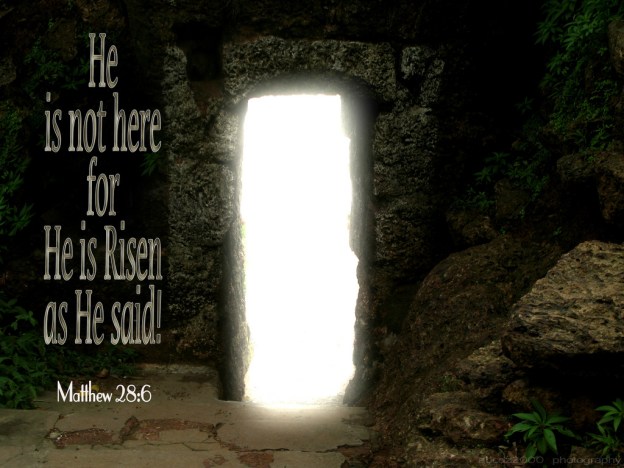
So on Sunday when the worship leader says to you “He has risen” and you say in return, “He has risen indeed,” understand that these words are not originally your memories, not your feelings. You can’t assert them on your own authority. And they are not empty Christianese code words. These are the words the angel spoke to the women at the empty tomb. But if you are clear about who said these words first and why, you can experience something of the joy, confidence and boldness of those who first heard them.

Note: This talk was delivered to a student gathering at Pepperdine University on Thursday, April 2, 2015.

“Why Hasn’t Jesus Returned?” And Other Objections to Christian Belief

Today I want to address another set of objections to Christian belief: “If Jesus really was raised from the dead, why didn’t he appear to everyone? Why didn’t he remain visibly present in the world instead of ascending to heaven (Acts 1:9-11)? Why didn’t the kingdom come in its fullness (Mark 9:1)? Why hasn’t he returned yet? Why do we have to “believe” instead of seeing?”

It seems to me that these questions arise from a sense of tension between the idea that Jesus’ resurrection is of universal significance and importance and two facts: (1) that it can be known today only indirectly, that is, by believing the written word of apostles and (2) that its impact on the world is much less obvious and universal than one would expect from such a dramatic divine act.

Of course these questions do not have to be taken as objections. They could be serious enquiries from people of faith seeking further understanding of the significance of what they believe. But the questioner could be implying that there are no answers and that the lack of answers disproves the fact-claim of the resurrection or at least that we must doubt the fact until we find satisfactory answers. Let’s deal with the challenger first and then we will address the serious enquirer.

We need to take the form of these objections seriously. They don’t make direct fact-denying assertions. They don’t ask “How?” or “Whether?” They ask “why?” When we ask why we are asking for the purpose or end for which someone has done something. If I ask you “Why did you do that?” I could be simply expressing my curiosity, or I could be making an accusation of wrongdoing.  If I see you digging in your back yard or climbing a ladder toward your roof or writing a letter, the question of why or to what end immediately arises in my mind. If you suddenly shove me to the ground, unless the reason for your aggression becomes immediately obvious, you won’t be surprised when I ask you why you did it. The act provokes the question because we assume that people don’t do things without an end in mind.

But suppose I never discover why you were climbing a ladder or why you pushed me to the ground. I do not conclude from my lack of knowledge of the purpose for your action that you didn’t do it. Indeed acts are always done for purposes, but we can know that an act was done without knowing why the actor did it. My knowledge of a fact rests on the evidence of my having experienced it or on believing the report of someone else who experienced it. Hence knowing the purpose of an act and knowing the fact of the act can be separated. With this distinction in mind, let’s return to the objections to faith with which I began.

As the New Testament recounts and reflects on the course of events after the resurrection of Jesus, it addresses the most pressing and essential questions. Why did Jesus die, and why did God raise him from the dead (See Acts 2:22-36)? Much of the theology of the New Testament is concerned to answer these questions. Of course these answers do not fully satisfy and leave us longing for deeper understanding. But the New Testament rarely addresses questions like those in our first paragraph. (2 Peter 3:3-13 is the most direct instance.) Such questions could be multiplied endlessly, for we can always speculate about why events didn’t happen in a different way or didn’t produce different results.

Many questions about Jesus won’t be answered fully until the end of history, because the event of Jesus’ death and resurrection concerns the whole human situation and all of human history. But our inability to find satisfactory answers to all of our why questions about the resurrection does not defeat belief in the resurrection itself any more than my ignorance of why you climbed a ladder yesterday defeats the fact of your climb. As long we keep our focus on the testimony of Paul, Peter, James, and the rest of those to whom Jesus appeared alive after his death, we need not let our many unanswered questions rob us of assurance of the fact of the resurrection.

Despite our inability to answer definitively the “why” questions in the first paragraph, I do not believe we are forced to remain completely silent in response to them. Some speculation, even if it is finally unconvincing, may increase our confidence that there are answers to these questions, even if we don’t know them. For nearly all human beings who have ever lived, God has been mysterious and hidden, unknown by clear sight or unambiguous demonstration.  But God has always been somewhat knowable by faith and reason through creation and conscience. We know that we are not our own creators and lawgivers (See Rom 1:18-32). Divine hiddenness creates an opportunity for faith, free decision, moral courage, and virtue—and their opposites.

In Jesus Christ, God becomes a factor inside human history in a new way, as a human character in the story. Critical questions about why Jesus didn’t show himself to everyone and didn’t end history fail to understand that Jesus Christ didn’t enter history to end it.  He came, rather, to save it, redeem it, and redirect it to its divinely appointed end. Even as God becomes in Christ a new factor in history, God remains hidden under the sign of the cross and in the foolishness of preaching (1 Cor 1:21). He does so for the same reason that God has always remained hidden, for the sake of faith, freedom, and virtue.

It would be strange to argue that God’s work of salvation and redemption contradicts or undoes God’s work in creation and providence. Apparently, God wants to accomplish his purpose for creation through its history and through human action. After all, creation is saved and perfected by the work of Jesus Christ whose action is both divine and human. And consistent with the mysterious ways of the Creator, Jesus’ divine action as Lord of All is hidden in his humanity and the humanity of his people.